The Lament of the Hen: Divine Willingness and Human Unwillingness 母鸡的哀鸣:神圣的“愿意”与人类的“不愿意”
Exploring the tension of Matthew 23:37 and Luke 13:34 through the lens of historical Christian faith, revealing the heart of Christ and the hardness of the human spirit. 通过历史基督教信仰的视角,探讨《马太福音》23:37和《路加福音》13:34中的这种张力,揭示基督的心肠与人类灵魂的刚硬。
Listen to English audio
聆听中文语音
1. Introduction: The Tears of the Creator
1. 引言:创造主的泪水
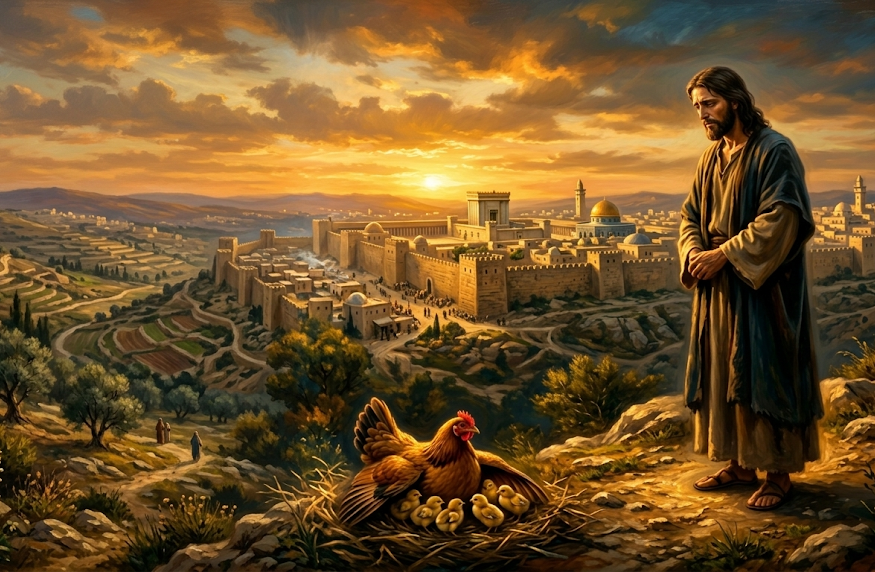
There are few scenes in the Gospels more poignant than Jesus Christ standing on the Mount of Olives, looking down upon the golden city of Jerusalem and weeping. His words are not those of a cold, indifferent judge, but of a rejected King who genuinely longs for the restoration of His people. In Matthew 23:37 and Luke 13:34, we encounter one of the most profound expressions of the “Revealed Will” of God toward a rebellious world.
福音书中很少有比耶稣基督站在橄榄山上,俯瞰着耶路撒冷这座黄金之城而哀哭的场景更为凄婉的了。祂的话语并非出自一位冷漠无情的审判官,而是一位被拒绝的君王之口,祂真心渴望着祂子民的复归。在《马太福音》23:37 和《路加福音》13:34 中,我们遇到了一段关于上帝对悖逆世界的“启示之旨意”(Revealed Will)最深刻的表达。
"O Jerusalem, Jerusalem, the city that kills the prophets and stones those sent to it! How often would I have gathered your children together as a hen gathers her brood under her wings, and you were not willing!"
— Matthew 23:37
“耶路撒冷啊,耶路撒冷啊,你常杀害先知,又用石头打死那奉差遣到你这里来的人。我多次愿意聚集你的儿女,好像母鸡把小鸡聚集在翅膀底下,只是你们不愿意。”
—— 马太福音 23:37
2. The Metaphor of the Hen: Condescending Love
2. 母鸡的比喻:屈尊俯就的爱
The use of the “hen and chicks” metaphor is a remarkable example of divine condescension. The Almighty God, who rules the heavens, likens Himself to a humble bird seeking to provide warmth and protection for her vulnerable young. Historically, the church has seen this as the outward call of the Gospel—a sincere invitation extended through the prophets and ultimately through the Son.
使用“母鸡与小鸡”的比喻是神圣屈尊的一个显著例子。那位统治诸天的全能上帝,竟然将自己比作一只寻找温暖并保护弱小幼雏的平凡母鸡。从历史上看,大公教会一直将其视为福音的外在呼召(External call)——这是通过先知并最终通过爱子发出的诚挚邀请。
Christ does not merely “provide” salvation; He “longs” to gather. This reveals that God’s holiness is never divorced from His compassion. The offer of refuge is real, and the protection offered under the shadow of His wings is perfect. Yet, the tragedy of the text lies in the final phrase: “and you were not willing.”
基督不仅仅是“提供”救恩;祂更“渴望”聚集。这揭示了上帝的神圣绝非脱离了祂的怜悯。避难所的提供是真实的,在祂翅膀荫下所提供的保护是完美的。然而,这段经文的悲剧性在于最后的一句话:“只是你们不愿意。”
3. The Distinction: Jerusalem and Her Children
3. 细微的分辨:耶路撒冷与其儿女
The logic of this passage has often been an area of theological discussion. Who is “Jerusalem,” and who are the “children”? In the historic Christian faith, many have observed that Christ addresses the city—specifically the leaders, the scribes, and the Pharisees who stood at the gates—as those who were “unwilling.” It was the religious establishment that sought to keep the “children” (the common people, the scattered remnant) from being gathered by the Messiah.
这一节经文的逻辑一直是神学讨论的一个焦点。谁是“耶路撒冷”,谁又是“儿女”?在历史悠久的基督教信仰中,许多人观察到基督是在对这座“城”——特别是站在城门口的领袖、文士和法利赛人——说话,指出是“他们”不愿意。正是这些宗教权贵,试图阻碍那些“儿女”(平民百姓,分散的余民)被弥赛亚聚集。
As a prominent historic observer noted:
正如一位著名的历史观察家所言:
"God gathered all whom He willed to gather, for His will was not made void by the will of those whom He gathered, or even by the will of those who were not gathered."
— Augustine of Hippo, *Enchiridion*
“凡上帝愿意聚集的,祂都聚集了;因为祂的旨意并未因那些被聚集者的意志而落空,甚至也未因那些未被聚集者的意志而落空。”
—— 希波的奥古斯丁,《手册》
4. The Human “Won’t”: A Slave to the Heart
4. 人类的“不愿”:一颗被奴役的心
This verse does not suggest a failure of God’s power, but rather the catastrophic reality of human rebellion. The “unwillingness” of Jerusalem is the proof of Total Depravity. We are not merely “unable” to come to Him as a neutral handicap; we “won’t” come because our hearts love the darkness.
这节经文并非在暗示上帝的能力失败了,而是在描述人类叛逆这一毁灭性的现实。耶路撒冷的“不愿意”是“全然败坏”(Total Depravity)的证明。我们不仅仅是处于某种中立状态下的“无力”来到祂面前;我们主观上“不愿意”来,因为我们的心爱黑暗。
To understand this “unwillingness,” we must look at another foundational text where Christ addresses the same spiritual deadlock. In John 5:40, He explicitly identifies the root of the problem:
要理解这种“不愿意”,我们必须看另一段基础性的经文,在那里基督论及了同样的属灵僵局。在《约翰福音》5:40中,祂明确指出了问题的根源:
"Yet you refuse to come to me that you may have life."
— John 5:40
“然而你们不肯到我这里来得生命。”
—— 约翰福音 5:40
5. Spurgeon’s Challenge: The Myth of Absolute Freedom
5. 司布真的挑战:绝对自由的迷思
Charles Spurgeon, in his renowned sermon Free Will—A Slave, addressed this very tension. He argued that while man has a “will” in a natural sense, that will is never neutral—it is always a slave to the heart’s desires. If a man’s heart is fallen, his “will” can only choose according to that fallen nature.
查尔斯·司布真(Charles Spurgeon)在著名的讲道《自由意志——一个奴仆》(Free Will—A Slave)中,探讨了这种张力。他认为,虽然人在自然意义上拥有“意志”,但这种意志绝非中立的——它始终是其内心欲望的奴隶。如果一个人的心是堕落的,他的“意志”只能根据那种堕落的本性做出选择。
As the “Prince of Preachers” famously declared:
正如这位“布道王子”那段著名的宣告:
"I do not believe in the 'free will' of man... Free will is a slave to evil thoughts, enslaved by the fallen nature. No man can come to Christ because he *will not* come, and he will not because his heart is in rebellion."
— C.H. Spurgeon
“我不相信人的‘自由意志’……自由意志已被邪恶的思想所奴役,被堕落的本性所捆绑。没有人能到基督这里来,因为他‘不肯’来;而他不肯来,是因为他的心正处于叛逆状态。”
—— C.H. 司布真
Spurgeon demonstrates that the “unwillingness” in Matthew 23:37 is not a lack of opportunity or a deficiency in the Gospel call. Rather, it is the active, stubborn resistance of the human spirit that would rather perish in its own strength than submit to the shadow of the Messiah’s wings. Without an intervention of grace, the human “will” is not free to choose God; it is perfectly free to choose its own destruction.
司布真论证道,《马太福音》23:37中的“不愿意”并非因为缺乏机会,也不是福音呼召本身有什么缺陷。相反,它是人类灵魂那种主动、顽梗的抵挡——宁愿在自己的力量中灭亡,也不愿降服在弥赛亚的翅膀荫下。若没有恩典的介入,人类的“意志”在选择上帝方面并非自由的;它在选择自我毁灭方面倒是完全自由的。
6. The Divine Necessity: Sovereign Grace
6. 神圣的必然:主权之恩典
If the will is a slave to sin, how can anyone be gathered? The answer lies in the power of the Gatherer, not the willingness of the gathered. If any are gathered under the Hen’s wings, it is because the Holy Spirit has performed a “resurrection” of the will—changing the heart so that the individual now desires what they once detested.
如果意志是罪的奴隶,那么有谁能被聚集呢?答案在于“聚集者”的能力,而非“被聚集者”的意愿。如果有任何人被聚集在母鸡的翅膀下,那是因为圣灵施行了意志的“复活”——改变了人的心,使这个人“现在”开始渴望他们曾经厌恶的事物。
Spurgeon concludes by pointing us away from our own resolve and toward Christ’s sovereign work:
司布真在结束时引导我们离开自己的决心,转向基督的主权工作:
"The work of salvation is entirely the Lord’s work from beginning to end. If you are ever to be saved, it must be because His sovereign grace overcomes your 'won't' and grants you a new 'will'."
— C.H. Spurgeon
“拯救的工作从始至终都是主的工作。如果你能得救,那必然是因为祂主权的恩典克服了你的‘不愿’,并赐予了你一颗新的‘心愿’。”
—— C.H. 司布真
The lament over Jerusalem shows that those who perish do so by their own active choice and stubbornness. They reject the very wings that would have saved them. The responsibility for their destruction lies entirely at their own doorstep, while the credit for any gathering lies entirely with the One who stoops to call.
对耶路撒冷的哀悼表明,那些灭亡的人是出于他们自己积极的选择和顽梗。他们拒绝了那原本可以拯救他们的翅膀。他们灭亡的责任完全在于他们自己,而任何被聚集的功劳则完全归于那位俯就呼召的主。
7. Conclusion: Fleeing to the Shadow of His Wings
7. 结语:逃向祂翅膀的荫下
The call of the Hen continues today through the preaching of the Word. It is a sincere, compassionate call to all: Come and be gathered. If you feel the hardness of your own heart, do not try to “will” yourself into righteousness. Instead, cry out to the One who weeps over the lost, asking Him to do for you what you cannot do for yourself—to gather you, by His irresistible mercy, under the safety of His eternal wings.
母鸡的呼唤在今天仍通过圣言的传讲而延续。这是一个对所有人发出、诚挚而慈悲的呼吁:来吧,被聚集吧。 如果你感受到自己内心的刚硬,不要试图通过自己的努力“立志”得救。相反,向那位为失丧者哀哭的主呼求,求祂为你行你所不能行的事——凭借祂那不可抗拒的怜悯,将你聚集在祂永恒翅膀的平安稳妥之中。