The Architecture of Grace: A Deep Dive into the Augustine-Pelagius Debate 恩典的架构:深入探讨奥古斯丁与伯拉纠之争
A deep exploration of the most significant theological debate in church history: the encounter between Augustine and Pelagius over grace, free will, and human nature. 深入探讨教会历史上最重要的神学辩论之一:奥古斯丁与伯拉纠关于恩典、自由意志和人性的交锋。
Listen to English audio
聆听中文语音
Historical Background
历史背景
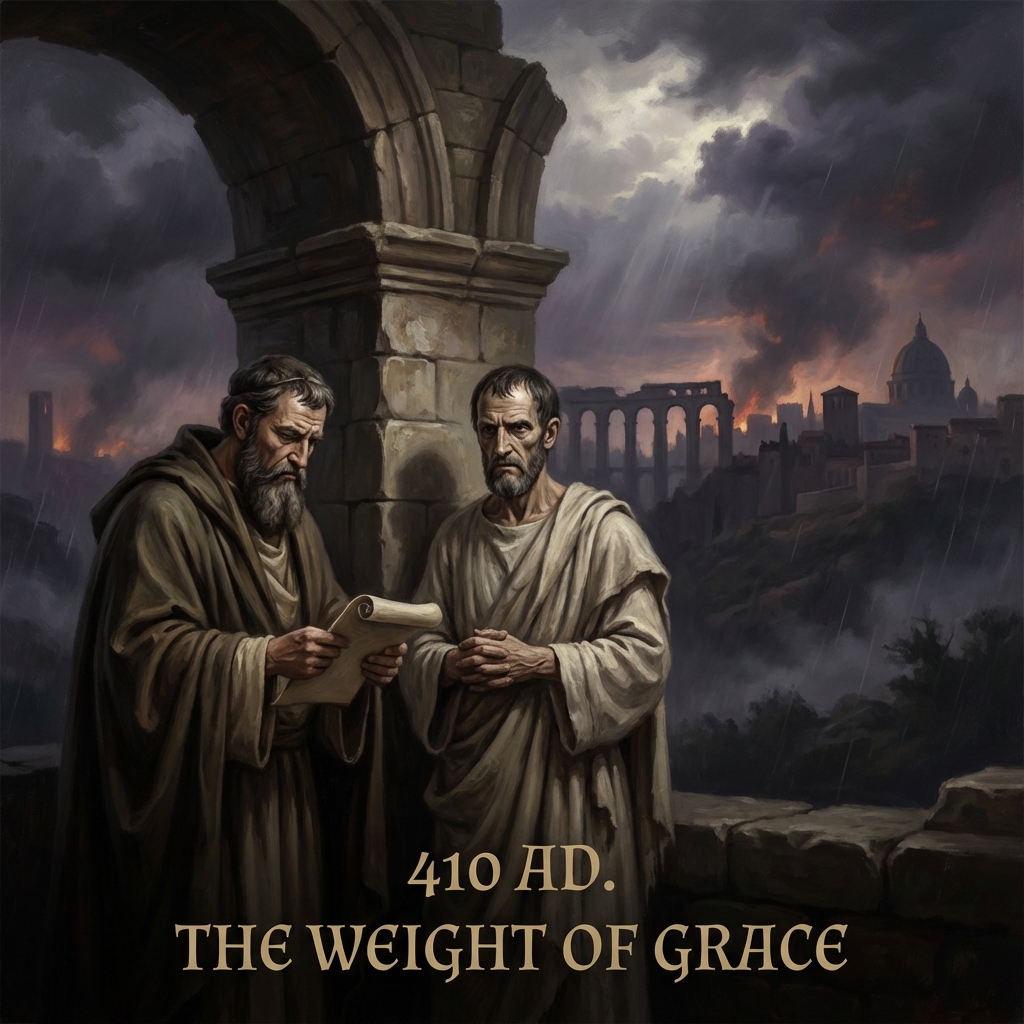
In the year 410 AD, the unthinkable happened: Rome fell. For a thousand years, the “Eternal City” had stood as the beacon of civilization, order, and power. Its sacking by the Visigoths sent shockwaves through the Mediterranean world, prompting a crisis of confidence that was as much psychological as it was political. If Rome could fall—the very symbol of human achievement and stability—what was secure?
在公元 410 年,不可想象的事情发生了:罗马陷落了。一千年来,“永恒之城”一直是文明、秩序和权力的灯塔。罗马被西哥特人洗劫的消息震惊了整个地中海世界,引发了一场心理与政治并存的信任危机。如果作为人类成就和稳定象征的罗马都能陷落,还有什么是安全的呢?
It was within this crucible of instability that two men—a North African bishop and a British monk—engaged in a battle for the soul of Western thought. Augustine of Hippo and Pelagius were not merely debating abstract religious dogmas; they were wrestling with the most fundamental questions of human existence: Are we fundamentally good or broken? Is progress a matter of effort or rescue? And what, ultimately, is the source of a changed life?
正是在这种动荡的熔炉中,两个男人——一位北非主教和一位英国修士——展开了一场争夺西方思想灵魂的较量。希波的奥古斯丁与伯拉纠不仅是在辩论抽象的宗教教义,他们还在搏斗关于人类存在的最根本问题:我们本质上是善良的还是破碎的?进步是努力的结果还是拯救的结果?最终,改变生命的源头是什么?
This debate, known to history as the Pelagian Controversy, remains the architectural blueprint for almost every major discussion on ethics, psychology, and spirituality in the West. To understand it is to understand the very grain of our own assumptions about ourselves.
这场在历史上被称为“伯拉纠争议”的辩论,至今仍是西方几乎所有关于伦理、心理学和灵性重要讨论的建筑蓝图。理解它,就是理解我们对自己假设的最深层逻辑。
Augustine and Pelagius: Two colliding visions of humanity and hope.
奥古斯丁与伯拉纠:两种冲突的人性观与希望观。
I. The Vision of the “Blank Slate” vs. the “Shattered Mirror”
I. “白板”与“破碎的镜子”之见
The disagreement began at the very beginning—with the nature of the human start.
分歧始于最初——即人类起点的本质。
Pelagius, a monk noted for his rigorous moral life, was deeply concerned by what he saw as the decadence of Roman society. He believed that the Christian life was a call to absolute moral perfection. His philosophy was built on the foundation of human neutrality. He argued that every child is born in the same state as Adam before his fall: a clean slate, or tabula rasa. For Pelagius, sin is not a condition we are born into; it is a choice we make.
伯拉纠是一位以严谨道德生活著称的修士,他对当时他眼中的罗马社会堕落深感忧虑。他认为基督徒生活是对绝对道德完美的呼召。他的哲学建立在人类中性论的基础上。他主张每个孩子出生时的状态与堕落前的亚当相同:一块洁净的白板(tabula rasa)。对于伯拉纠来说,罪不是我们与生俱来的状态,而是我们的选择。
He famously argued that the “Fall” of Adam was merely a bad precedent—a historical stumble that later generations unfortunately imitated. However, this stumble did not damage the human machine itself. Our wills remain perfectly balanced, capable of choosing virtue with the same ease as vice. In this view, humanity is like a runner who has seen someone trip; we might be tempted to trip as well, but our legs are perfectly healthy, and the path remains open. Perfection, therefore, is not a supernatural gift but a natural possibility.
他留下了一个著名的观点:亚当的“堕落”仅仅是一个坏先例——后代不幸模仿的历史性失足。然而,这次失足并未损害人类机器本身。我们的意志保持着完美的平衡,能够像选择恶一样轻易地选择美德。在这种观点下,人类就像一个看到别人绊倒的奔跑者;我们也可能会被诱惑去绊倒,但我们的双腿是完全健康的,道路依然敞开。因此,完美不是超自然的恩赐,而是自然的可能。
Augustine, however, looked at the same world and saw something far more tragic. Drawing from his own tumultuous journey of conversion—an experience of deep-seated addiction to his own desires—Augustine argued that human nature is not a “blank slate” but a shattered mirror.
然而,奥古斯丁在同一个世界中看到了更为悲剧的一幕。他从自己动荡的归正之旅中汲取经验——那是一种对其欲望根深蒂固成瘾的体验——奥古斯丁主张人性并非“白板”,而是一面破碎的镜子。
The Fall, in Augustine’s view, was a catastrophic failure of the human instrument. He introduced the concept of a deep, inherited orientation toward the self. We are not merely born into a world of bad examples; we are born with a “bent” toward the ego.
在奥古斯丁看来,堕落是人类仪器的灾难性失效。他引入了深度继承的自我导向观念。我们不只是出生在一个充满坏榜样的世界里;我们出生时就自带一种趋向自我的“弯曲”。
 Human nature as a shattered mirror: capable of reflection, but fundamentally fractured.
人性如破碎的镜子:虽能反射,但本质上已断裂。
Augustine argued for a concept of Federal Headship. He saw Adam not just as a single historical figure, but as the representative of the human race. When Adam fell, the entirety of human nature fell with him. It was as if the “source code” of humanity had been corrupted.
奥古斯丁主张代表首领制(Federal Headship)的概念。他不仅将亚当视为一个单一的历史人物,而且将其视为全人类的代表。当亚当堕落时,全人类的人性也随之堕落。这仿佛人类的“源代码”遭到了损坏。
"Therefore, just as sin came into the world through one man, and death through sin, and so death spread to all men because all sinned." (Romans 5:12)
“这就如罪是从一人入了世界,死又是从罪来的;于是死就临到众人,因为众人都犯了罪。”(罗马书 5:12)
When the root of the tree was poisoned, every branch and leaf that followed shared in that poison. We do not just commit sins; we are, in our very core, oriented away from the highest good. We are, as he famously put it, non posse non peccare—not able not to sin.
当树根中毒时,随之而来的每一根树枝和每一片叶子都会带有那毒素。我们不仅是犯下了罪;我们在核心深处都是背离最高美善的。正如他那句名言所说:non posse non peccare——即不能不犯罪。
II. The Paradox of Capability: “Ought” vs. “Can”
II. 能力的悖论:“应当”与“能够”
Pelagius’s philosophy can be summarized in a pithy ethical maxim: “If I ought, I can.”
伯拉纠的哲学可以用一句简练的伦理格言来概括:“如果我应当,我就能。”
He believed that God is fundamentally just, and a just God would never command something that a human being is incapable of doing. If God commands us to “be perfect as your Father in heaven is perfect,” it must mean that we have the inherent natural capacity to achieve that perfection. To suggest otherwise, Pelagius argued, was to make God a tyrant who punishes people for failing at a task they were never equipped to perform. This is the heart of the “Moralist” position: responsibility implies ability.
他认为上帝在本质上是公义的,一位公义的上帝绝不会命令人类去做其无法做到的事情。如果上帝命令我们“要像你们的天父那样完美”,那一定意味着我们具有实现那种完美的内在自然能力。伯拉纠主张,如果不这样认为,就是把上帝变成一个暴君,惩罚人们未能完成一项他们从未具备能力去执行的任务。这就是“道德主义者”立场的关键:责任意味着能力。
Augustine countered this with what seemed like a scandalous paradox. He observed that the commands of God are not given to show us what we can do, but to reveal what we cannot do. The law, in Augustine’s view, acts as a diagnostic tool. Just as a thermometer reveals a fever but cannot cure it, the moral law reveals our spiritual impotence.
奥古斯丁用一个看似荒谬的悖论反驳了这一点。他观察到,上帝的诫命不是为了向我们展示我们能做什么,而是为了揭示我们不能做什么。在奥古斯丁看来,律法充当了一个诊断工具。正如温度计能显示发烧但不能治愈发烧一样,道德律揭示了我们在灵性上的无能。
"For by works of the law no human being will be justified in his sight, since through the law comes knowledge of sin." (Romans 3:20)
“所以凡有血气的,没有一个因行律法能在神面前称义,因为律法本是叫人知罪。”(罗马书 3:20)
Augustine’s most famous prayer—the one that reportedly drove Pelagius to fury—was: “Give what You command, and command what You will.”
奥古斯丁最著名的祈祷——据说这曾让伯拉纠大发雷霆——是:“求你赐下你所命令的,并随你所愿地发出命令。”
This prayer admitted that even obeying God’s commands requires a gift from God Himself. For Pelagius, this was a recipe for moral laziness and a denial of human dignity. For Augustine, it was the only honest response to the human condition. We “ought” to love God perfectly, but we “cannot” because our hearts are captured by lesser loves. Our problem is not a lack of information, but a lack of inclination. The command exists to drive us to the one who can provide the power we lack.
由于这个祈祷承认即使是遵守上帝的诫命也需要上帝亲自赐予能力。对于伯拉纠来说,这是产生道德懒惰和否定人类尊严。但对于奥古斯丁来说,这是对人类状况唯一诚实的回应。我们“应当”完美地爱神,但我们“不能”,因为我们的心被更次要的爱俘虏了。我们的问题不是缺乏信息,而是缺乏倾向。诫命的存在是为了将我们推向那能提供我们所缺乏之大能的那一位。
III. The Anatomy of Grace: Assistance vs. Re-creation
III. 恩典的剖析:协助与重造
This disagreement over capability led to two radically different definitions of “grace.”
这种关于能力的分歧导致了对“恩典”两种截然不同的定义。
For Pelagius, grace was primarily external and informative. He did not deny the need for grace, but he redefined it. Grace, to Pelagius, consisted of three things:
- Nature: The inherent capacity of the will to choose good. This is “grace” given at creation.
- The Law: The clear instructions provided in Scripture.
- The Example of Christ: A perfect model for us to follow.
对于伯拉纠来说,恩典主要是在外部的和提供信息的。他并不否认对恩典的需求,但他重新定义了它。对伯拉纠来说,恩典包含三件事:
- 本性:意志选择善的内在能力。这是创造时赋予的“恩典”。
- 律法:圣经中提供的明确指示。
- 基督的榜样:供我们效法的完美典范。
In this framework, grace is like a GPS system. It tells you where to go and warns you of traffic, but you are the one driving the car. The power to move is entirely yours. Grace facilitates the work, but it does not perform it.
在这个框架下,恩典就像一个 GPS 系统。它告诉你该往哪儿走,并警告你注意交通,但开车的人是你。前进的动力完全取决于你。恩典促进了工作的开展,但它不执行工作。
For Augustine, this kind of “grace” was a death sentence. If your car has a shattered engine, a GPS system is useless. Augustine argued that grace must be internal and operative. True grace is not just a light shining on the path; it is the gift of sight to the blind man so he can see the path. It is not just an example to follow; it is the power to love the example.
而对于奥古斯丁来说,这种“恩典”无异于死刑判决。如果你的汽车引擎破碎了,GPS 系统就没用了。奥古斯丁主张恩典必须是内在且生效的。真正的恩典不只是照亮道路的光;它是赐予盲人的视力,使他能看见道路。它不仅仅是一个供效法的榜样;它是爱那榜样的力量。
Augustine insisted that for a person to turn toward God, God must first perform a “sovereign heart surgery.” He must change the fundamental desires of the soul. This is the difference between Synergism (God and man working together as equals) and Monergism (God acting first and alone to bring the dead to life).
奥古斯丁坚持认为,一个人要转向神,神必须首先进行一次“主权性心脏手术”。祂必须改变灵魂最根本的渴望。这就是协同论(Synergism,神和人作为平等的伙伴合作)与独作论(Monergism,神首先且独自行动以使死人复活)之间的区别。
"No one can come to me unless the Father who sent me draws him. And I will raise him up on the last day." (John 6:44)
“若不是差我来的父吸引人,就没有能到我这里来的;到我这里来的,在末日我要叫他复活。”(约翰福音 6:44)
Augustine’s grace is “Preventing Grace” (Gratia Praeveniens)—a grace that comes before any human effort. It does not wait for us to ask; it creates the desire to ask. It is an irresistible force of love that overcomes our resistance. It is not a violation of the will, but a restoration of it.
奥古斯丁的恩典是“先行恩典”(Gratia Praeveniens)——即在任何人类努力之前来到。它不是等待我们祈求,而是创造了祈求的欲望。它是一种无法抗拒的爱之力量,克服了我们的反抗。它不是对意志的侵犯,而是对意志的修复。
"And I will give you a new heart, and a new spirit I will put within you. And I will remove the heart of stone from your flesh and give you a heart of flesh." (Ezekiel 36:26)
“我也要赐给你们一个新心,将新灵放在你们里面,又从你们的肉体中除掉石心,赐给你们肉心。”(以西结书 36:26)
As he eloquently stated, God “sweetly and powerfully” inclines the heart. It is the difference between a doctor offering medicine to a patient who can choose to take it, and a rescuer performing CPR on someone who has ceased breathing.
正如他雄辩地陈述的那样,上帝“既甜蜜又强力地”倾向人心。这就是医生向可以选择服药的病人提供药物,与救援人员对已停止呼吸的人进行心肺复苏之间的区别。
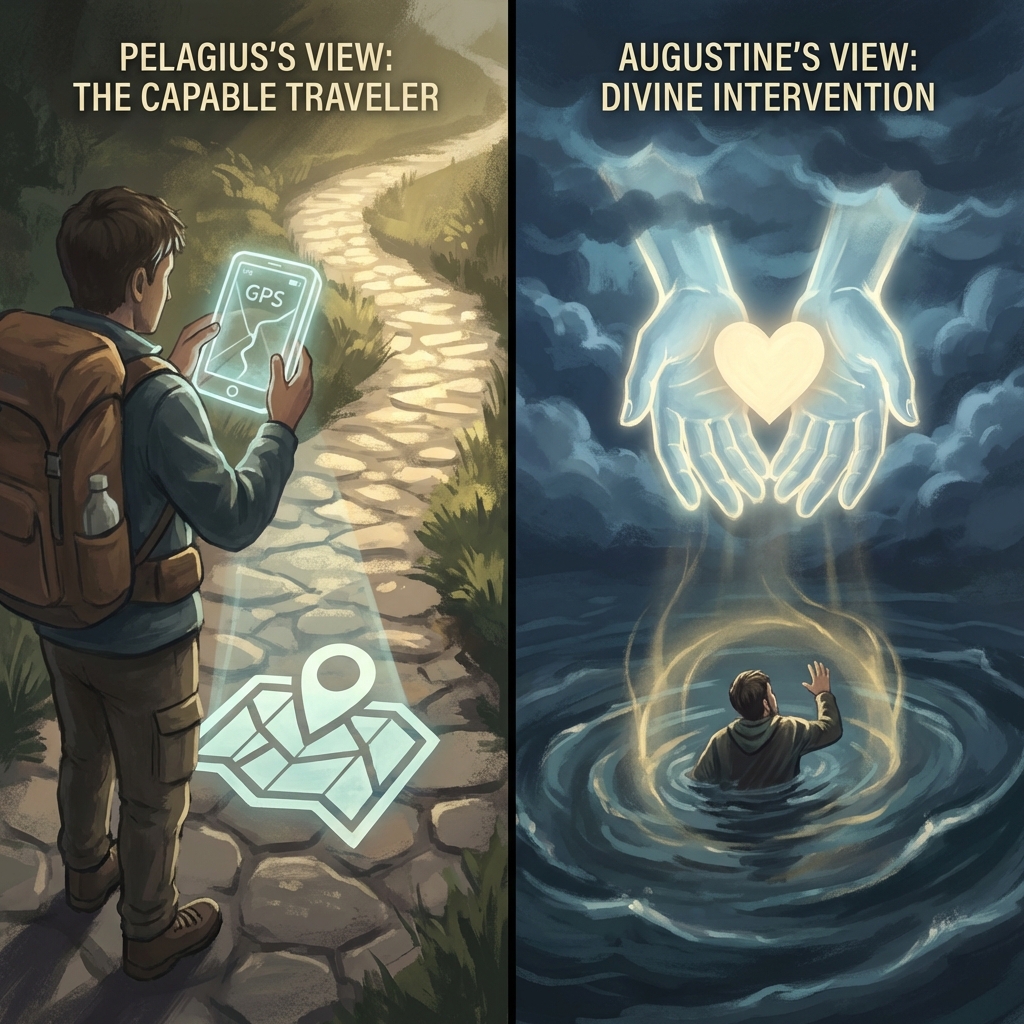 Two views of grace: A GPS for the capable traveler vs. a divine rescue for the drowning.
两种恩典观:为有能力的旅行者提供的 GPS,与为溺水者提供的神圣救援。
IV. The Choice of the Will: Freedom vs. Liberty
IV. 意志的选择:选择自由与真正自由
One of the most misunderstood parts of this debate is the concept of “free will.” Modern observers often assume Pelagius defended free will while Augustine denied it. In reality, both affirmed that humans make choices. The difference lay in the constraints and source of those choices.
这场辩论中最容易被误解的部分之一是“自由意志”的概念。现代观察者通常认为伯拉纠捍卫了自由意志,而奥古斯丁否认了它。实际上,两人都肯定人类会做出选择。区别在于这些选择的约束和来源。
Pelagius believed in a Libertarian Freedom—the idea that at any moment, regardless of past habits or internal nature, a person can choose A or B with equal ease. The will is an independent agent, disconnected from the heart’s desires. It is a “neutral” faculty that can swing either way.
伯拉纠相信一种意志自由论(Libertarian Freedom)——即在任何时刻,无论过去的习惯或内在倾向如何,一个人都能以同样的轻松选择 A 或 B。意志是一个独立的代理人,与内心的欲望脱节。它是一个可以向任何方向摆动的“中立”功能。
Augustine argued for a more psychologically profound view, often called Compatibilism. He distinguished between free choice and true liberty. We are always “free” to choose what we want most at any given moment; no one is physically forcing us to sin. However, because our nature is corrupted, our “want most” is always centered on the self.
奥古斯丁主张一种在心理学上更为深刻的观点,通常被称为相容论(Compatibilism)。他区分了“自由选择”(free choice)和“真正自由”(true liberty)。在任何时刻,我们总是“自由地”选择我们最想要的东西;没有人强迫我们去犯罪。然而,由于我们的本性已经腐化,我们“最想要”的总是以自我为中心。
A man who is thirsty is “free” to drink salt water if that is all he sees, but he is not “at liberty” to satisfy his thirst with it. He is a slave to his circumstance and his need. Similarly, Augustine argued that while the will is technically “free” from external coercion, it is “in bondage” to its own corrupted desires.
一个口渴的人如果只看见盐水,他可以“自由”地喝下去,但他并没有“自由”以此满足自己的干渴。他是处境和需求的奴隶。同样,奥古斯丁主张,虽然意志在技术上不受外部强迫,但它却“受其自身腐化欲望的束缚”。
"For the mind that is set on the flesh is hostile to God, for it does not submit to God's law; indeed, it cannot. Those who are in the flesh cannot please God." (Romans 8:7-8)
“原来体贴肉体的,就是与神为仇,因为不服神的律法,也是不能服。而且属肉体的人不能得神的喜欢。”(罗马书 8:7-8)
True liberty (Libertas)—the freedom to love God and neighbor purely—is not something we possess by nature; it is something we receive by grace. We are “free” to follow our nature, but we are captives to that nature until a higher power changes what we love.
真正的自由(Libertas)——即纯洁地爱神和爱邻舍的自由——并不是我们天生拥有的;它是我们通过恩典获得的。我们可以“自由”地顺从我们的天性,但在更高的力量改变我们的所爱之前,我们是那天性的俘虏。
V. The Transmission of Corruption: How the Poison Spreads
V. 腐化的遗传:毒素如何扩散
A key battleground in this debate was the mechanism of how sin moves from generation to generation.
这场辩论的一个关键战场是罪如何在各代之间移动的机制。
Pelagius argued for Transmission by Imitation. He believed we become sinners because we grow up in a society of sinners and choose to follow their example. If a child could be raised in a perfectly holy environment, Pelagius believed they could remain perfectly holy. Sin is a learned behavior.
伯拉纠主张通过模仿遗传。他认为我们成为罪人是因为我们在罪人的社会中长大,并选择效法他们的榜样。如果一个孩子能在完全神圣的环境中长大,伯拉纠相信他们就能保持完全神圣。罪是一种习得的行为。
Augustine countered with Transmission by Propagation. He argued that the corruption of the Fall is deeper than social conditioning; it is biological and spiritual. Because we are born from “fallen stock,” we inherit the defect of our parents.
奥古斯丁则以通过繁衍遗传进行反驳。他认为堕落带来的腐化比社会调节更为深刻,它是生理和灵性层面的。因为我们诞生于“堕落的根源”,我们继承了父母的缺陷。
To visualize this, imagine a factory that produces compasses. If the master mold is bent, every compass produced from that mold will point slightly to the east instead of north. You can give the compass a “bad example” or a “good example,” but its needle will always settle in the wrong direction because its very alignment is flawed. This “original sin” is not a personal fault we are blamed for at birth, but a shared vulnerability and a lack of the original righteousness that Adam possessed. It is a deprivation of the light that should guide us.
为了将此形象化,请想象一个生产指南针的工厂。如果母模是弯曲的,那么根据该模具生产出的每个指南针都会稍微指向东方而不是北方。你可以给指南针一个“坏榜样”或一个“好榜样”,但它的指针总会停在错误的方向,因为它的对齐本身就是有缺陷的。这种“原罪”不是我们出生时被指责的个人过错,而是一种共有的脆弱性,以及缺乏亚当原本拥有的那种原始正义。这是一种照亮我们前行之光的缺失。
VI. The Semi-Pelagian Compromise and the Final Verdict
VI. “半伯拉纠”的妥协与最终定论
The debate did not end with the death of the two main protagonists. In the decades that followed, a “middle way” emerged, particularly in Southern France, which history has labeled Semi-Pelagianism.
辩论并未随着两位主角的去世而结束。在随后的几十年里,一种“中间道路”出现了,尤其是在法国南部,历史称之为半伯拉纠主义(Semi-Pelagianism)。
These thinkers (like John Cassian and Faustus of Riez) wanted to find a balance. They agreed with Augustine that the Fall had seriously damaged humanity and that grace was necessary. However, they wanted to preserve a small “spark” of human initiative. They argued that while God provides the grace for salvation, the first step toward God—the initial “yes” or the first cry for help—must come from the human will alone. They viewed salvation as a partnership: man reaches out his hand, and God, seeing the effort, pulls him up.
这些思想家(如约翰·卡西安和里耶的福斯图斯)希望寻找一个平衡点。他们同意奥古斯丁的观点,即堕落严重损害了人类,恩典是必不可少的。然而,他们想要保留人类主动性的小小“火花”。他们主张,虽然上帝为救恩提供了恩典,但面向神走出的第一步——最初的“是”或第一声求救——必须仅仅来自人类驱动的意志。他们将救恩视为一种伙伴关系:人伸出手,上帝由于看到了人的努力而将其拉起。
To the followers of Augustine, this was simply Pelagianism in a more subtle mask. They argued that if the “first step” comes from us, then salvation ultimately rests on a human work. If the “cry for help” is the deciding factor, then the human being is still, in some way, the master of their own destiny.
对于奥古斯丁的追随者来说,这仅仅是戴上更微妙面具的伯拉纠主义。他们主张,如果“第一步”来自我们,那么救恩最终就取决于人类的一项善功。如果“求救”是决定性因素,那么人类在某种程度上仍然是自己命运的主宰。
"For by grace you have been saved through faith. And this is not your own doing; it is the gift of God, not a result of works, so that no one may boast." (Ephesians 2:8-9)
“你们得救是本乎恩,也因着信;这并不是出于自己,乃是神所赐的;也不是出于行为,免得有人自夸。”(以弗所书 2:8-9)
The controversy reached its definitive theological conclusion at the Council of Orange in 529 AD. The council affirmed the Augustinian position with uncompromising clarity. It declared that even the “desire for cleansing” and the “beginning of faith” are gifts of the Holy Spirit. It rejected the idea that we can do anything to “deserve” or “initiate” grace. Grace, the council insisted, is what makes the desire for grace possible in the first place. This was the final victory of the view that salvation is a work of God from beginning to end—Sola Gratia.
这场争议在公元 529 年的奥兰治会议(Council of Orange)上得出了明确的神学结论。会议以毫不妥协的清晰态度肯定了奥古斯丁的立场。它宣布即使是“洁净的渴望”和“信心的开始”也是圣灵的赐予。它拒绝了我们可以做任何事情来“配得”或“启动”恩典的观点。会议坚持认为,恩典才是最初使对恩典的渴望成为可能的原因。这是救恩从始至终都是神的工作这一观点——唯独恩典(Sola Gratia)——的最终胜利。
VII. The Enduring Resonance: Why It Matters Today
VII. 持久的共鸣:为何今日它依然重要
Why does a 1,600-year-old debate still matter? Because the “Pelagian impulse” is the default setting of the human heart and modern culture.
为什么一场 1600 年前的辩论依然重要?因为“伯拉纠冲动”是人类心灵和现代文化的默认设置。
In our world of self-help, “manifesting,” and the belief in the infinite malleability of the self, we are all instinctive Pelagians. We believe that if we just have the right information, the right environment, and enough willpower, we can perfect ourselves and our societies. When things go wrong, we look for “bad examples” or “faulty systems” to blame, rarely looking at the inherent fracture in the human instrument itself. We believe that we are the captains of our souls and the masters of our fates.
在我们的自助服务、“显化”以及对自我无限可塑性的信仰世界中,我们都是本能的伯拉纠主义者。我们相信,如果我们有正确的信息、正确的环境和足够的意志力,我们就能完善自己和我们的社会。当事情出错时,我们会寻找“坏榜样”或“有缺陷的系统”来归咎,很少审视人类机器本身内在的断裂。我们相信我们是自己灵魂的统帅,是航向命运的主人。
Augustine’s vision offers a different, more sober, yet ultimately more hopeful perspective. It suggests that our problems are deeper than we care to admit, but the solution is more radical than we can imagine.
奥古斯丁的愿景提供了一个不同的、更冷静但也最终更具希望的视角。它表明我们的问题比我们愿意承认的要深,但解决方案也比我们能想象的更加彻底。
If we are “neutral,” then everything depends on us. Life becomes a crushing treadmill of self-improvement and moral anxiety. If we fail, it is entirely our fault because we had the power to succeed. This leads either to pride (if we think we are succeeding) or despair (if we know we are failing).
如果我们是“中性”的,那么一切都取决于我们。生活变成了一个自我完善和道德焦虑的沉重跑步机。如果我们失败了,那完全是我们的错,因为我们本有成功的力量。这要么导致骄傲(如果我们认为自己正在成功),要么导致绝望(如果我们知道自己正在失败)。
But if we are truly broken and in need of rescue, then we can stop trying to “climb” and start learning to receive. The Augustinian view recognizes that the most human thing we can do is admit our impotence, for it is only in that admission that we become candidates for the kind of grace that doesn’t just assist, but actually restores.
但如果我们真的破碎并需要救援,那么我们就可以停止尝试“攀爬”,开始学习接受。奥古斯丁的观点认为,我们能做的最像人的事情就是承认自己的无能,因为只有在那种承认中,我们才能成为那种不只是协助、而是实际修复我们的恩典的候选者。
In the end, the architecture of grace is built on a simple, counter-intuitive truth: we find our true strength only when we stop pretending we have it, and we find our true freedom only when we admit we are bound. The light of Rome may have flickered, but the debate it sparked continues to illuminate the depth of our need and the height of a love that descends to meet it.
最后,恩典的架构建立在一个简单且反直觉的真理之上:只有当我们不再假装拥有力量时,我们才能找到真正的力量;只有当我们承认自己受束缚时,我们才能找到真正的自由。罗马的光芒可能已经熄灭,但它引发的这场辩论将继续照亮我们需求的深度,以及那屈尊俯就来满足这需求的大爱之高度。
Suggested Further Reading
- Confessions by Augustine of Hippo
- The Spirit and the Letter by Augustine of Hippo
- The Bondage of the Will by Martin Luther (A later engagement with these same themes)
- The Pelagian Controversy by B.B. Warfield
- Augustine and His World by Andrew Brown
建议进一步阅读
- 《忏悔录》——希波的奥古斯丁
- 《灵与字》——希波的奥古斯丁
- 《意志的束缚》——马丁·路德(后来对这些相同主题的探讨)
- 《伯拉纠争议》——B.B. 沃菲尔德
- 《奥古斯丁及其世界》——安德鲁·布朗