Misunderstood Sola Fide: From Legalistic Bondage to the Great Exchange 被误解的“唯独信心”:从律法主义的枷锁到伟大的交换
Discover how the biblical doctrine of justification shifts our foundation from self-righteous moral efforts to the finished, alien righteousness of Christ, bringing true spiritual peace. 在这个自我称义的时代,发掘圣经中因信称义的法庭宣告如何将我们从疲惫的道德挣扎中释放,并赐下神恩独作的永恒平安。
Listen to English audio
聆听中文语音
1. The Relatable Search for Worthiness
The human heart is a factory of self-justification, a relentless engine attempting to manufacture worthiness from the raw materials of moral effort. We see this not only in our spiritual lives but in every corner of the human experience—the exhausting struggle to earn a parent’s approval, a peer’s respect, or a sense of internal peace through performance. This universal impulse leads to what Norman Shepherd aptly described as “legalistic bondage,” a state where one’s standing before the Divine is perpetually precarious, dependent on the fluctuating quality of one’s own works.
The Reformation doctrine of Sola Fide, or “Faith Alone,” emerged not as a dry theological abstraction, but as a radical solution to this relatable problem. While the term sounds simple, it was the “principal axis” upon which the Reformation turned. It asserts that our acceptance before God is not a wage earned by the worker, but a gift received by the believer, shifting the foundation of our identity from our own fickle efforts to the finished work of another.
1. 寻求配得感的共鸣
人心是一个自我称义的工厂,是一台无休止的发动机,试图用道德努力的原材料制造出“配得感”。我们不仅在属灵生活中看到这一点,而且在人类经验的每一个角落都能看到——为了赢得父母的认可、同伴的尊重,或通过表现获得内心的平静而进行令人筋疲力尽的挣扎。这种普遍的冲动导致了诺曼·谢泼德(Norman Shepherd)恰如其分地描述的“律法主义的束缚”,在这种状态下,一个人在神面前的地位永远是岌岌可危的,取决于自己行为质量的波动。
宗教改革的“唯独信心”(Sola Fide)教义的出现,并不是作为一个枯燥的神学抽象概念,而是作为解决这一引起共鸣的问题的激进方案。虽然这个词听起来很简单,但它是宗教改革赖以运转的“主轴”。它断言,神对我们的接纳不是工人赚得的工价,而是信徒领受的礼物,它将我们身份的根基从我们自己反复无常的努力转移到另一位已经完成的工作上。
2. The Principal Axis: More Than Just a Hinge
While popular history often describes justification by faith as the “hinge” of the Reformation, the scholar R. Scott Clark (Heidelblog) notes that John Calvin employed a more precise architectural image: the “principal axis” (praecipuus cardo).
There is a vital distinction here. As we ordinarily use a hinge, a door swings open and shut, but it does not revolve 360 degrees. An axis, however, is the central point around which an entire system revolves. Calvin argued that unless a person first grasps their relationship to God and the nature of His judgment, they have no foundation upon which to establish salvation or build true “piety toward God.” By centering the faith on this praecipuus cardo, all other subsidiary teachings—from the nature of the church to the role of the sacraments—stay in their proper orbit. Without this axis, the foundation of salvation collapses into a heap of moralism.
"And we must so discuss them as to bear in mind that this is the main axis (praecipuus…cardinem) on which religion turns, so that we devote the greater attention and care to it."
— John Calvin, Institutes 3.11.1
2. 主轴:不仅是一个铰链
虽然通俗历史常常将因信称义描述为宗教改革的“铰链”,但学者R. 斯科特·克拉克(R. Scott Clark,海德堡博客)指出,约翰·加尔文采用了一个更精确的建筑意象:“主轴”(praecipuus cardo)。
这里有一个至关重要的区别。按照我们通常使用铰链的方式,门只能打开和关闭,但它不会360度旋转。然而,轴是整个系统围绕其旋转的中心点。加尔文认为,除非一个人首先掌握了他们与神的关系以及神的审判的本质,否则他们就没有基础来确立救恩或建立真正的“对神的敬虔”。通过将信仰置于这个“主轴”之上,所有其他附属教导——从教会的本质到圣礼的作用——都将留在它们各自正确的轨道上。没有这个轴,救恩的根基就会坍塌成一堆道德主义。
“所以我们讨论这题目时必须牢记:宗教既然以此为主轴(praecipuus…cardinem),我们就当对它付出更大的注意与关怀。”
——约翰·加尔文,《基督教要义》 3.11.1
3. The Forensic Paradox: A Courtroom, Not a Hospital
To understand Sola Fide, one must distinguish between the “Forensic” view of the Reformation and the “Infused” view formulated during the Sixth Session of the Council of Trent.
In the Roman view, justification is a medical process—an “infusion” of grace where God gradually imparts holiness into the believer, making them actually righteous over time. It is important to note that the Roman view does not exclude grace; rather, it insists that Christ’s work must be supplemented by what man does. In contrast, the Reformation view is strictly forensic—a legal declaration within the courtroom of God. God does not wait for the sinner to become holy in a “hospital” setting before accepting them; instead, He acts as a Judge who declares the ungodly “not guilty” based on a righteousness that is not their own.
"To the one who does not work, but believes in Him who justifies the ungodly, his faith is reckoned as righteousness."
— Romans 4:5
3. 法庭悖论:是法庭,而不是医院
要理解“唯独信心”,必须区分宗教改革的“法庭式”(Forensic)观点与天特会议第六次会议期间制定的“注入式”(Infused)观点。
在罗马天主教看来,称义是一个医疗过程——恩典的“注入”,神逐渐将圣洁分给信徒,使他们随着时间的推移真正变得公义。值得注意的是,罗马天主教的观点并不排斥恩典;相反,它坚持认为基督的工作必须由人的作为来补充。相比之下,宗教改革的观点是严格的法庭式的——在神的法庭内的合法宣告。神并不在“医院”的环境中等到罪人变得圣洁之后才接纳他们;相反,祂作为一位法官,根据不属于他们自己的公义宣告不敬虔的人“无罪”。
“惟有不做工的,只信称罪人为义的神,他的信就算为义。”
——罗马书 4:5
4. The Great Exchange: The Ultimate Accounting Miracle
The mechanism of this forensic declaration is known as “Double Imputation,” a two-fold accounting transaction where the records of Christ and the believer are swapped. At the heart of this miracle is the concept of “Alien Righteousness” (iustitia aliena)—a righteousness that exists extra nos, or “outside of us.” The Apostle Paul famously summarizes this exchange in his letter to the Corinthians:
"For our sake he made him to be sin who knew no sin, so that in him we might become the righteousness of God."
— 2 Corinthians 5:21
- Our Unrighteousness to Him: The believer’s sin, guilt, and debt are laid upon Christ. He assumes the sinner’s identity and bears the full satisfaction of God’s justice.
- His Righteousness to Us: Christ’s perfect obedience and holiness are credited (imputed) to the believer’s account.
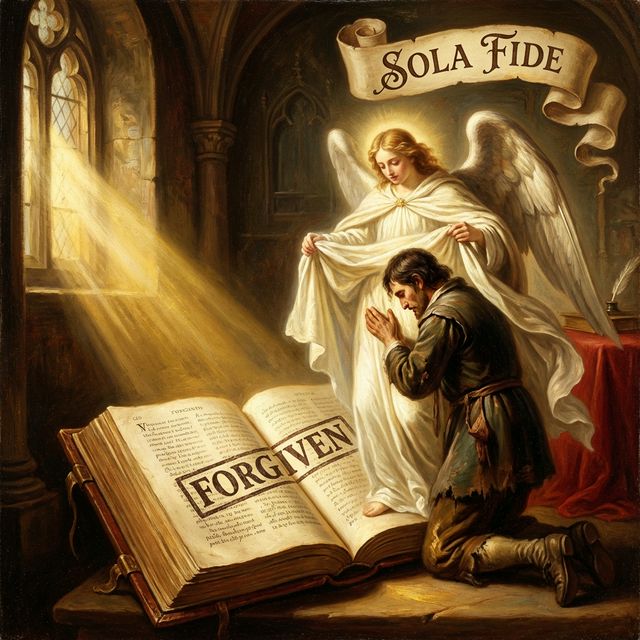
This results in the profound visual of being “clothed” or “draped in a robe” of righteousness. We are not merely forgiven; we are clothed in Christ’s identity. In this “Great Exchange,” the Father views the redeemed sinner through the lens of His Son’s perfection, seeing them as equally righteous as Christ Himself. This breathtaking reality was marvelled at even by the early church in the anonymous Epistle to Diognetus:
"O sweet exchange! O unsearchable operation! O benefits surpassing all expectation! that the wickedness of many should be hid in a single righteous One, and that the righteousness of One should justify many transgressors!"
— Epistle to Diognetus (2nd Century)
4. 伟大的交换:终极的会计奇迹
这种法庭宣告的机制被称为“双重归算”(Double Imputation),这是一种双重的会计交易,基督和信徒的账目被交换了。这个奇迹的核心是“外来的公义”(iustitia aliena)的概念——一种存在于 extra nos 或“我们之外”的公义。使徒保罗在写给哥林多教会的信中精辟地总结了这一交换:
“神使那无罪的,替我们成为罪,好叫我们在他里面成为神的义。”
——哥林多后书 5:21
- 我们的不义归给祂: 信徒的罪、内疚和债务都加在基督身上。祂承担了罪人的身份,并完全满足了神的公义。
- 祂的公义归给我们: 基督完美的顺服和圣洁被记入(归算)到信徒的账上。
这产生了被公义“穿上”或“披戴上外袍”的深刻视觉效果。我们不仅仅是被原谅;我们穿上了基督的身份。在这个“伟大的交换”中,父神透过祂儿子完美的滤镜来看待被救赎的罪人,将他们视为与基督本身同等的公义。哪怕是早期教会,在匿名的《致丢格那妥书》中,也对这令人惊叹的事实发出了由衷的赞叹:
“哦,何等甘甜的交换!何等深不可测的作为!何等出人意料的恩惠!许多人的罪孽竟被隐藏在一位义人里面,而一位义人的公义竟使许多违纪者得称为义!”
——《致丢格那妥书》(公元二世纪)
5. The Dead Man’s Response: Why Monergism Matters
A central pillar of Sola Fide is “Monergism,” the belief that God the Holy Spirit is the sole active party in regeneration. This stands in opposition to “Synergism,” which views salvation as a cooperative venture between God’s grace and man’s will.
Using the analogy of a spiritual corpse, R.C. Sproul explains that a person is “utterly passive” in their rebirth. This clarifies the Ordo Salutis (Order of Salvation): in the monergistic view, regeneration precedes faith. Because we are dead in sin, we cannot assist in our own resuscitation; we require “Operative Grace” (God working alone) rather than “Cooperative Grace” (God waiting for our assistance).
"A corpse cannot revive itself. It cannot even assist in the effort. It can only respond after receiving new life."
— R.C. Sproul
This ensures that salvation is “Grace Alone,” removing all human boasting. Faith is not a contribution we make to secure a reward, but a gift we receive because we have been made alive.
5. 死人的回应:神恩独作论为何重要
“唯独信心”的核心支柱是“神恩独作论”(Monergism),即相信圣灵在重生中是唯一的积极主动方。这与“神人合作论”(Synergism)相对立,后者将救恩视为神的恩典与人的意志之间的合作。
R.C. 斯普劳尔用属灵尸体的比喻解释说,一个人在重生时是“完全被动的”。这澄清了“救恩的次序”(Ordo Salutis):在神恩独作论的观点中,重生先于信心。因为我们死在罪中,我们无法协助自己的复苏;我们需要的是“运作的恩典”(神独自做工),而不是“合作的恩典”(神等待我们的协助)。
“一具尸体无法使自己复活。它甚至无法提供协助。它只能在接受新生命后做出回应。”
——R.C. 斯普劳尔
这确保了救恩是“唯独恩典”,消除了人类所有的夸口。信心不是我们为了确保获得奖赏而做出的贡献,而是因为我们活过来而领受的一份礼物。
6. The Source of Faith: A Divine Gift, Not a Human Product
When we say “justification by faith alone,” a subtle danger arises: we might begin to view faith itself as a new kind of “work” or contribution we bring to God. We might ask, “Did I muster up enough faith to be saved?” This misunderstands the very source of faith.
Solid biblical theology reveals that faith is not a product of human free will, which is naturally bound by sin and unable to seek God on its own. Rather, faith itself is entirely a sovereign gift from God. The Holy Spirit creates faith in our hearts through the hearing of the Gospel.
"For it has been granted to you that for the sake of Christ you should not only believe in him but also suffer for his sake."
— Philippians 1:29
Even the hands we reach out to receive the gift of salvation were given to us by God. The Apostle Paul famously dismantles any human contribution in Ephesians 2:8-9, explicitly stating two “nots” regarding our salvation:
"For by grace you have been saved through faith. And this is not your own doing; it is the gift of God, not a result of works, so that no one may boast."
— Ephesians 2:8-9
- Not your own doing: The faith we exercise does not originate from within our fallen nature. It is an alien gift implanted by the Spirit.
- Not a result of works: Faith is itself not a meritorious act or moral exertion we perform to earn God’s favor.
This profound understanding of faith as a divine gift dates back to the early church fathers, who defended the absolute necessity of grace against human pride.
"Let us understand that God gives to us the grace to believe. [...] For we do not first believe, in order that we may attain the gift of grace, but we attain the gift of grace in order that we may believe."
— Augustine of Hippo, On the Predestination of the Saints
Thus, “Faith Alone” ultimately points back to “Grace Alone”—ensuring that from beginning to end, all glory belongs to God, not to our own ability to believe.
6. 信心的来源:神圣的礼物,而非人的产品
当我们在说“唯独信心”时,一种微妙的危险就出现了:我们可能会开始将“信心”本身视为一种新的“行为”,或我们向神献上的贡献。我们可能会问:“我是否积攒了足够的信心来获得拯救?”这完全误解了信心的真正来源。
深邃的圣经神学指出,信心不是人类自由意志的产物,因为人的意志本性上被罪所捆绑,无法主动寻求神。相反,信心本身完全是神主权之下赐予的礼物。圣灵借着我们听信福音,在我们心中生发了信心。
“因为你们蒙恩,不但得以信服基督,并要为他受苦。”
——腓立比书 1:29
哪怕是我们伸出去领受救恩礼物的那双手,也是神赐给我们的。使徒保罗在《以弗所书》2:8-9中著名地粉碎了任何关于人类贡献的企图,明确指出了关于我们得救的“两个不是”:
“你们得救是本乎恩,也因着信。这并不是出于自己,乃是神所赐的;也不是出于行为,免得有人自夸。”
——以弗所书 2:8-9
- 不是出于自己(Not of yourselves): 我们所运用的信心并非源自我们自身堕落的本性,它是圣灵植入的一份外来的神圣礼物。
- 也不是出于行为(Not a result of works): 信心本身绝不是我们为了赢得神恩宠而进行的一种有功德的行为或道德努力。
这种对神主权赐下信心之恩典的深刻理解可以追溯到极力对抗人类骄傲并捍卫恩典必需性的早期教父。
“让我们明白,神赐给我们相信的恩典……因为我们不是因为先相信才获得了恩典的礼物,而是我们获得了恩典的礼物才得以相信。”
——希波的奥古斯丁,《论圣徒的预定》
因此,“唯独信心”最终指向了“唯独恩典”——确保从始至终,所有的荣耀都归于神,而不是归于我们自己相信的能力。
7. The Mirror of James: When “Faith Alone” Isn’t Alone
A common challenge to Sola Fide arises from the Epistle of James, which states that a person is justified by works and not by faith alone. However, this is a conflict of terminology, not theology. Paul speaks of soteric justification (our legal status before God), while James speaks of demonstrative justification, or Vindication (how our faith is shown to be authentic before men).
Works are the evidence of a prior soteric justification, not the cause of it. For James, “faith-alone” (hyphenated) is often an intellectual abstraction, but true faith is an act of trust. As the Heidelberg Catechism (Q64) notes, it is impossible for those grafted into Christ not to bring forth “fruits of thankfulness.”
"Justification is by faith alone, but not by faith that is alone."
— Martin Luther
7. 雅各的试金石:当“唯独信心”不再孤单
对“唯独信心”的一个常见挑战来自雅各书,书中说人称义是因着行为,不是单因着信。然而,这是术语的冲突,而不是神学的冲突。保罗谈论的是救恩性称义(我们在神面前的合法地位),而雅各谈论的是证明性称义,或称为辩护(我们的信心如何在人前显明为真)。
行为是在先的救恩性称义的证据,而不是其原因。对雅各来说,“单独的信心”往往是一种理性的抽象,但真正的信心是一种信靠的行为。正如《海德堡探题》(问64)所指出的,那些被连于基督的人,不可能不结出“感恩的果子”。
“称义唯独靠信心,但这信心绝不孤立。”
——马丁·路德
8. Conclusion: The Gift of Infallible Assurance
The doctrine of Sola Fide replaces the “legalistic bondage” of performance-based acceptance with “infallible assurance.” In the modern theological landscape, this remains under siege by the “New Perspective on Paul” (NPP) and figures like N.T. Wright, who attempt to shift justification from a “status before God” to a “membership in a community.”
However, we must reject this modern shadow. If our standing depended on our membership or our “fluctuating performance,” assurance would be a phantom. But because our standing is secured by Christ’s “completed work,” our assurance is infallible. Justification is a once-and-for-all legal declaration that anchors the soul.
Final Ponderable: If your standing with the Divine was based entirely on someone else’s perfect record rather than your own fluctuating performance, how would that change the way you live tomorrow morning?
8. 结论:绝对确据的礼物
“唯独信心”的教义用“绝对的确据”取代了基于表现而被接纳的“律法主义枷锁”。在现代神学版图中,这仍受到“保罗新观”(New Perspective on Paul, NPP)及N.T. 赖特等人的围攻,他们试图将称义从“在神面前的地位”转变为“共同体中的成员资格”。
然而,我们必须拒绝这种现代阴影。如果我们的地位取决于我们的成员资格或我们“波动的表现”,那么确据将是一个幻影。但是,因为我们的地位是由基督“已完成的善工”所保障的,我们的确据是绝对的。称义是一次性且永远的法律宣告,是灵魂的锚。
最后的思考: 如果你在神面前的地位完全基于另一位完美的记录,而不是你自己波动的表现,那将会如何改变你明天早上的生活方式?