From Augustinianism to Synergism: The Theological Evolution of the Roman Catholic Church 天主教是如何从奥古斯丁主义蜕变到人神合作的光景的?
A historical and theological analysis of how the Roman Catholic Church transitioned from Augustinian monergism to the doctrine of synergism. 探讨罗马天主教如何从奥古斯丁的一元论转向神人合作论的历史与神学演变过程。
Listen to English audio
聆听中文语音
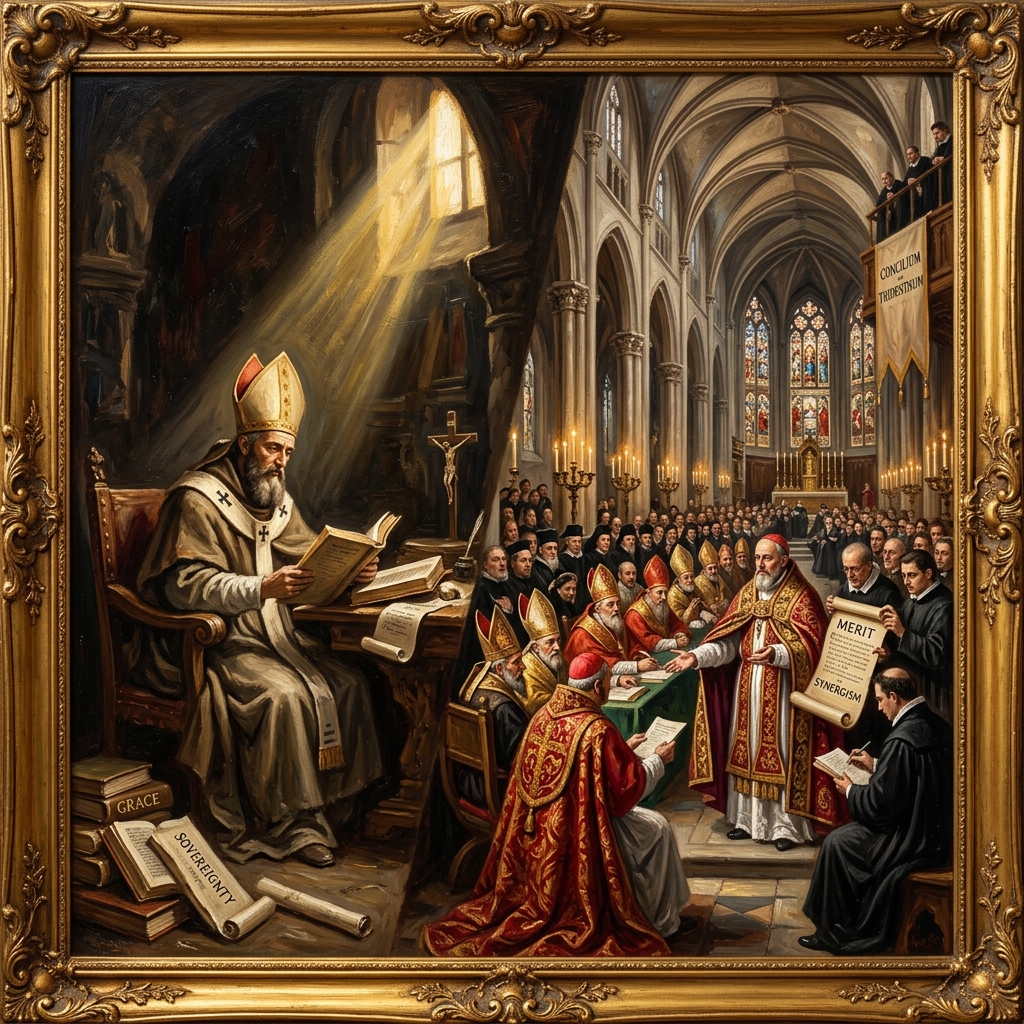
Introduction: A Deep Historical Tension
引言:深具历史张力的演变
The Roman Catholic Church originally claimed to uphold the teachings of St. Augustine, having formally condemned Pelagianism and Semi-Pelagianism in the early centuries. Why, then, does it now hold firmly to the doctrine of “synergism” (divine-human cooperation)?
天主教本来是承认奥古斯丁主义的,也曾对伯拉纠和半伯拉纠主义做出过正式的批判,为何如今却抱持了“神人合作”(Synergism)的观念呢?要理解这个转变,我们需要看到这是一个历经千年、充满了神学张力与政治博弈的过程。
1. The “Selective Inheritance” of Augustine
1. 对奥古斯丁的“选择性继承”
The early Church, through the Council of Orange (529 AD), formally condemned Pelagianism and established the principle that the initiative in salvation belongs to God’s grace. However, in its inheritance of Augustine, the Roman Catholic tradition performed a subtle “surgery”:
早期教会确实通过奥兰治会议(Council of Orange, 529年)正式定罪了伯拉纠和半伯拉纠主义,确立了“救恩的主动权在上帝恩典”的原则。然而,天主教在继承奥古斯丁时,做了一个微妙的切割:
It acknowledged “Prevenient Grace”—the belief that without God’s grace, man cannot take the first step toward God. However, it gradually marginalized Augustine’s later teachings on “Irresistible Grace” and “Unconditional Election,” which carried a strong sense of divine predestination.
它承认“预防性恩典”(Prevenient Grace)是必须的,即没有神的恩典,人绝不能迈出向神的第一步。然而,它却逐渐冷落了奥古斯丁中后期关于“不可抗拒的恩典”和“无条件的拣选”等带有强烈“命定论”色彩的教义。
The result was an “Augustinian shell with a Semi-Pelagian core.” The Church maintained that while grace precedes action, it must be “cooperated with” by human free will to become effective.
这导致了一种“奥古斯丁式的外壳,半伯拉纠式的内核”的演变。天主教认为,恩典虽然先行,但必须由人的自由意志来“配合”才能产生实效。
2. Scholasticism and the Framework of “Merit”
2. 经院哲学与“功德观”的介入
By the Middle Ages, Scholasticism—led by figures like Thomas Aquinas—sought to balance divine sovereignty with human responsibility. While Aquinas deeply respected Augustine, he introduced a legal framework for “merit.”
到了中世纪,以托马斯·阿奎那为代表的经院哲学试图平衡上帝主权与人的责任。虽然阿奎那在本质上是非常尊重奥古斯丁的,但他引入了“功德”(Merit)的法理框架。
Aquinas argued that God’s grace empowers man to do good works, and these works, driven by grace, are viewed by God as worthy of merit. This transition was partly driven by institutional needs: as the mediator of grace, the Church required a system of “sacraments, penance, and good works.” If salvation depended entirely on God’s unpredictable election, the necessity of the papal authority and the sacramental system might be diminished.
他认为上帝的恩典赋予了人行善的能力,而这些在恩典驱动下的善行,被上帝视为有价值的功德。这一转变部分是出于体制化的需要:教会作为恩典的中保,需要建立一套“礼仪、告解、善功”的体制。如果救恩完全取决于上帝不可预测的拣选(如严格的奥古斯丁主义),那么教会的圣礼体制和教宗的权柄就会显得不那么“必不可少”。
3. The Council of Trent: The Definitive Break
3. 天特会议(Council of Trent)的决裂
The Protestant Reformation was the final catalyst for this shift. When Martin Luther and John Calvin invoked “Sola Gratia” and “Absolute Predestination,” claiming to be the true heirs of Augustine, Rome was forced to respond.
宗教改革是这个转向的终点。当马丁·路德和加尔文打出“唯独恩典”和“绝对命定”的旗号,宣称自己是奥古斯丁的真正继承者时,天主教被迫做出了反击。
At the Council of Trent, the Roman Catholic Church formally established the doctrine of synergism to distinguish itself from the Reformers. It condemned the view that the human will is “purely passive” in the presence of grace.
在天特会议上,天主教为了与新教划清界限,正式确立了“神人合作”的教义。会议定罪了那种认为“人的意志在恩典面前完全是被动”的观点。
“If any one saith, that man’s free will moved and excited by God… cannot refuse its consent, if it would, but that, as something inanimate, it does nothing whatever and is merely a passive subject: let him be anathema.” — Council of Trent, Decree on Justification, Canon 4
“如果有人说,人的自由意志受到上帝的推动和激发……却不能拒绝其同意(即便他想拒绝),而是像某种无生命之物一样,什么都不做,纯粹是一个被动的主体:那么他应当被咒诅。” —— 天特会议(Council of Trent),关于称义的法令,第四条
4. Jesuit Influence and Molinism
4. 耶稣会与莫林纳主义(Molinism)
In the late 16th century, the Jesuit theologian Luis de Molina proposed a theory that would set the tone for modern Catholic synergism. He introduced the concept of “Middle Knowledge” (Scientia Media).
16世纪末,耶稣会神学家莫林纳(Luis de Molina)提出的理论,几乎为现代天主教的“神人合作”定下了基调。他引入了“中介知识”(Middle Knowledge)的概念。
Molinism posits that God knows how every person would freely choose in any given circumstance and arranges His plan accordingly. This logic preserves God’s omniscience while granting absolute autonomy to human free will. This perspective significantly influenced later Arminian views within Protestantism as well.
莫林纳认为上帝预知人在每种情况下会如何自由选择,并以此来安排祂的计划。这在逻辑上既保全了上帝的全知,又给了人的自由意志绝对的自主空间。正如我们之前讨论的,亚米念主义在很多法理逻辑上,其实是受到了这种天主教反宗教改革运动中衍生出的“自由意志观”的启发。
5. A Perspective from the Historic Christian Faith
5. 来自大公教会正统神学的透视
From the perspective of the Historic Christian Faith, this Roman Catholic shift is viewed as a “compromise with human pride.” It dilutes the depth of the fall and the severity of sin.
从大公教会正统神学(Historic Christian Faith)的视角来看,天主教的这一转向是“向人性的骄傲妥协”,它稀释了坠落的深度和罪的严重性。
While synergism claims that man is “badly wounded,” the historic orthodox view is that man is “dead in trespasses and sins.” A dead man cannot cooperate with a doctor until the doctor first imparts the life of resurrection.
神人合作论虽然承认人“受了重伤”,但正统的神学观认为人已经彻底“死在过犯罪恶之中”。死人是无法配合医生的,除非医生先施予复活的生命。
"Even when we were dead in our transgressions, He made us alive together with Christ (by grace you have been saved)."
— Ephesians 2:5
“当我们死在过犯中的时候,便叫我们与基督一同活过来(你们得救是本乎恩)。”
—— 以弗所书 2:5
Furthermore, if salvation involves human cooperation, the believer can never have true assurance. One would never know if their “cooperation” was sincere enough or if their “merits” were sufficient.
此外,如果救恩涉及人的合作,那么信徒就永远无法获得真正的救恩确据,因为你永远不知道自己的“合作”是否足够诚恳、善功是否足够圆满。
Conclusion: Authority vs. Grace
总结:权柄与恩典的博弈
The Roman Catholic Church did not “stop” acknowledging Augustine; rather, it transformed him into a “gentle tutor,” stripping away the radical views of divine sovereignty that would threaten the ecclesiastical structure.
天主教并非“不承认”奥古斯丁,而是将奥古斯丁改造为一个“温和的导师”,剔除了其中会让教会体制感到不安的极端主权观。
Today, its adherence to synergism is essential to maintaining its sacramental theology and the authority structure of the universal church. To Rome, this is a “balance”; but to the historic faith, it is a departure from “Sola Gratia.” This is why historical orthodoxy has always been wary of any “synergistic” crack—it is the gateway through which human merit re-enters the house of grace.
如今的天主教持守“神人合作”,本质上是为了维护其圣礼神学和普世教会的权威结构。在他们看来,这是一种平衡;而在大公教会的正统信仰看来,这是对“唯独恩典”的偏离。这就是为什么正统神学总是警惕任何“人神合作”的裂缝——因为那就是让“功德观”重新渗透进来的缺口。