The Great Schism: A Detailed Forensic and Theological Investigation into the Condemnation of Luther and Calvin 伟大的分裂:对路德与加尔文定罪过程的详细历史与神学调查
A monumental study of the legal excommunication of Martin Luther, the systematic anathemas of the Council of Trent, and the intellectual conflict with John Calvin. Estimated reading time: 45 minutes. 关于马丁·路德法理绝罚、天特会议系统性咒诅以及与约翰·加尔文思想冲突的史诗级研究。预计阅读时间:45 分钟。
Listen to English audio
聆听中文语音
I. The Forensic Breaking Point: The Legal Trial of Martin Luther (1517–1521)
The Reformation did not begin with a desire to leave the Church, but with a question about an indulgence. However, within four years, this question evolved into a total legal and ecclesiastical rupture. To understand the “excommunication” of Luther, we must look at the specific legal documents that defined his status as an outlaw.
一、 法理断裂点:马丁·路德的法律审判 (1517–1521)
宗教改革并非始于离开教会的愿望,而是始于对比萨(赦罪券)的质疑。然而,在短短四年内,这一质疑演变成了一场彻底的法律与教会关系的破裂。要理解路德的“绝罚”,我们必须查看那些定义其法外之徒身份的具体法律文本。
1. The Leipzig Debate (1519) and the Discovery of Authority
Before the formal excommunication, the legal turning point was the Leipzig Debate between Martin Luther and the Catholic apologist Johann Eck. Eck, a master of canon law, forced Luther to admit that not only the Pope, but also Church Councils (like the Council of Constance) could err. This admission was legally fatal. It moved the case from a local German dispute to a charge of Apostasy and Heresy against the very foundation of the Church’s authority.
1. 莱比锡辩论 (1519) 与权威的发现
在正式绝罚之前,法律上的转折点是马丁·路德与天主教辩论家约翰·埃克(Johann Eck)之间的莱比锡辩论。埃克是教会法大师,他迫使路德承认,不仅教宗会犯错,甚至教会大公会议(如康斯坦茨会议)也会犯错。这一承认在法律上是致命的。它将此案从德国的地方性争议推向了针对教会权威根基的“叛教”与“异端”指控。
2. Exsurge Domine (June 1520): The 41 Errors
Pope Leo X responded with the bull Exsurge Domine. This was a “conditional” excommunication. It listed 41 specific sentences from Luther’s works and condemned them as heretical, scandalous, or offensive to pious ears. Some of the specific errors condemned included:
- Error 2: “To deny that sin remains in a child after baptism is to treat both Paul and Christ with contempt.”
- Error 10: “Sins are not forgiven to anyone, unless when the priest forgives them he believes they are forgiven.”
- Error 25: “The Roman Pontiff, the successor of Peter, is not the vicar of Christ over all the churches of the entire world, instituted by Christ Himself in blessed Peter.”
2. 《主啊,求你起来》 (1520 年 6 月): 41 条错误
教宗利奥十世发布了敕令《主啊,求你起来》(Exsurge Domine)作为回应。这是一份“有条件的”绝罚令。它列举了路德著作中的 41 条具体论断,并谴责它们为异端、令人反感或亵渎虔诚。其中被谴责的具体错误包括:
- 错误 2:否定受洗后的儿童仍存留罪性,是对圣保罗和基督的蔑视。
- 错误 10:除非信徒相信罪已赦免,否则神父的赦免在法律上无效。
- 错误 25:罗马教宗并非基督在全世界教会的代理人,亦非基督亲自在彼得身上所设立。
3. Decet Romanum Pontificem (January 1521): The Iron Gate
On January 3, 1521, Luther was formally and finally excommunicated. The legal language was absolute. The Church did not just bar him from communion; it declared him a “dead branch” cut off from the Vine.
3. 《罗马教宗理应如此》 (1521 年 1 月): 铁门落下
1521 年 1 月 3 日,路德被正式且最终绝罚。其法律语言是绝对的。教会不仅禁止他领受圣体,还宣布他为一条从葡萄树上切断的“枯枝”。
We decrease and declare the said Martin to be a heretic… We prohibit each and every one of the faithful, under pain of excommunication, to read, possess, or print any books composed by the said Martin. (Decet Romanum Pontificem)
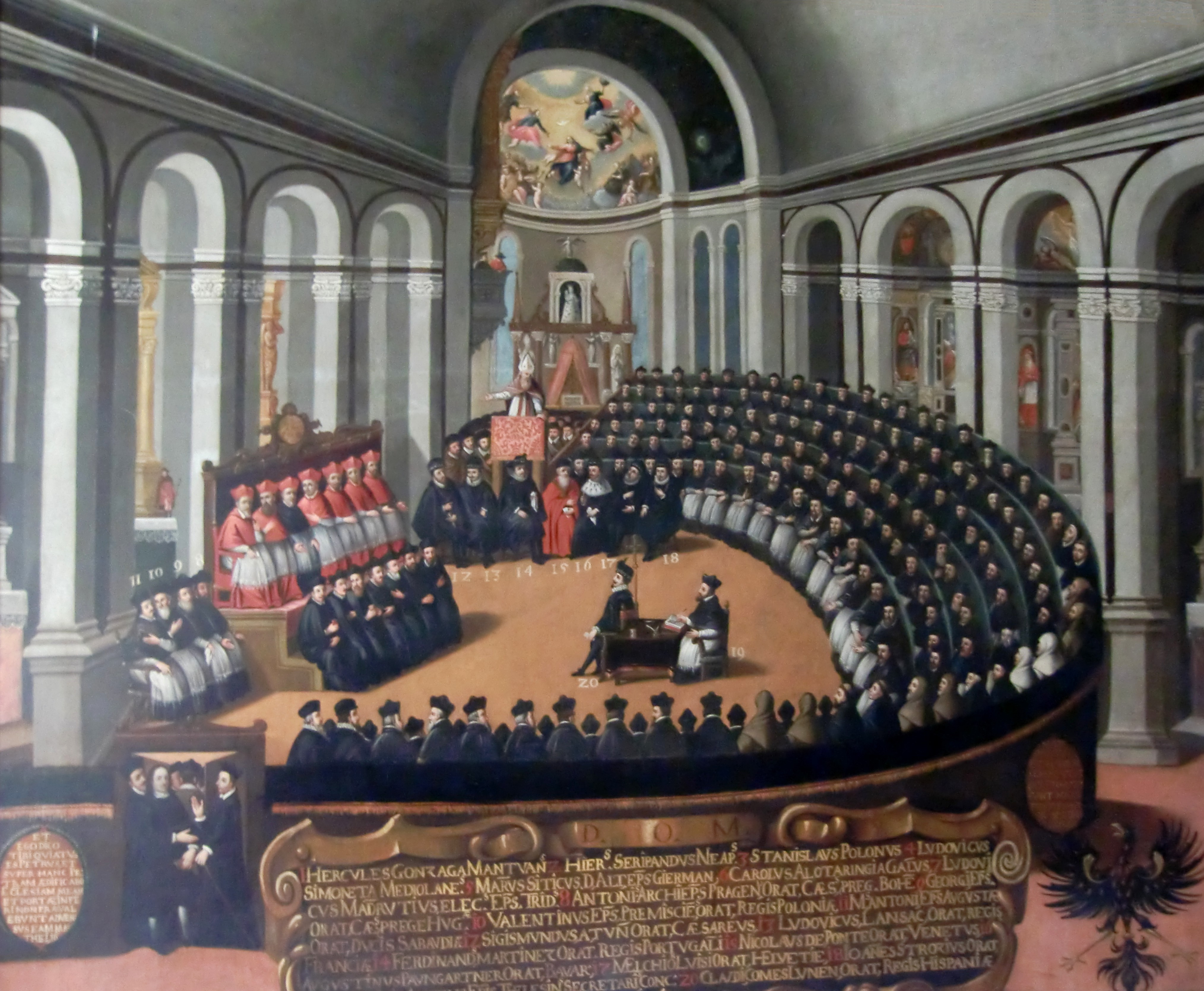
II. Premeditated Condemnation: The Council of Trent (1545–1563)
The Council of Trent was the greatest legal factory in the history of the Western Church. It was not a debate; it was a Judgment. The Council spent 18 years refining the laws that would permanently define the boundary between “Catholicism” and “Heretical Sects.”
二、 蓄谋已久的定罪:天特会议 (1545–1563)
天特会议是西方教会历史上规模最大的法律工厂。它不是一场辩论,而是一场 审判。会议历时 18 年,不断完善那些永久定义“天主教”与“异端教派”边界律法。
1. Session IV: Scripture, Tradition, and the Vulgate
The Reformers argued for Sola Scriptura (Scripture Alone). Trent responded by making the Bible and the unwritten Traditions of the Church equal in authority.
1. 第四会期:圣经、圣传与武加大译本
改革者主张“唯独圣经”(Sola Scriptura)。天特会议通过宣布圣经与教会 口传来下的圣传 在权威上完全平等作为回应。
Decree on the Canonical Scriptures:
“The Council … receives and venerates with an equal affection of piety and reverence, all the books both of the Old and of the New Testament … as also those said traditions … preserved by unbroken succession in the Catholic Church.”
Anathema Clause:
“If any one receive not, as sacred and canonical, the said books entire with all their parts … let him be anathema.”
关于正典圣经的法令:
“本会议……以同样的虔诚与敬畏之情,接受并尊崇旧约与新约的所有书卷……以及那些……在天主教会内代代相传、从未中断的圣传。”
咒诅条款:
“若有人不接受上述书卷及其所有部分为神圣且正典的……此人应受咒诅。”
2. Session VI: The Forensic War on “Justification”
This is the heart of the 30-minute study. Session VI contains 16 chapters of explanation and 33 “Canons” or curses. It is here that Luther’s theology is meticulously dissected and burnt.
2. 第六会期:关于“称义”的法庭战争
这是本次 30 分钟研究的核心。第六会期包含 16 章解释说明和 33 条“法典”(即咒诅)。正是在这里,路德的神学被细致地剖析并焚毁。
Canon 4: On Free Will
Luther wrote The Bondage of the Will, stating that the will is like a horse ridden by God or Satan. Trent responded:
“If any one saith, that man’s free will moved and excited by God, by assenting to God… does not at all cooperate… let him be anathema.”
第 4 条法典:关于自由意志
路德写下了《意志的束缚》,称意志就像一匹被上帝或撒旦骑着的马。天特会议回应道:
“若有人说,人的自由意志在受到上帝触动和激励时,通过同意上帝的召唤……却完全不与之配合……此人应受咒诅。”
Canon 11: Against Imputed Righteousness
Luther taught that we are “righteous” only because Christ’s merit is “imputed” (legally credited) to us. Trent rejected this “external” righteousness:
“If any one saith, that men are justified, either by the sole imputation of the justice of Christ, or by the sole remission of sins, to the exclusion of the grace and the charity which is poured forth in their hearts by the Holy Ghost… let him be anathema.”
第 11 条法典:反对归算的义
路德教导说,我们之所以被称为“义人”,仅是因为基督的功德被“归算”(法律上的确认)给了我们。天特会议拒绝了这种“外加”的义:
“若有人说,人称义唯独靠着基督之义的归算,或唯独靠着罪的赦免,而排除了圣灵倾注在他们心中的恩典与仁爱……此人应受咒诅。”
Canon 12: Against Faith Alone
“If any one saith, that justifying faith is nothing else but confidence in the divine mercy which remits sins for Christ’s sake… let him be anathema.”
第 12 条法典:反对唯独信心
“若有人说,称义的信心不过是相信上帝的怜悯,即信上帝因基督的缘故赦免人的罪……此人应受咒诅。”
III. John Calvin: The Systematic Enemy
If Luther was the blunt instrument, Calvin was the surgical strike. The Roman Catholic Church viewed Calvin as the most dangerous of all heretics because he built a parallel world.
三、 约翰·加尔文:系统性的公敌
如果说路德是钝器,那么加尔文就是外科手术般的打击。罗马天主教会将加尔文视为所有异端中最危险的一个,因为他构建了一个 平行的世界。
1. The Institutes and the Subversion of Order
The Church saw the Institutes of the Christian Religion (1536) as an “Architect’s Guide to Destroying the Apostolic Church.” Calvin did not just point at the Pope’s corruption; he argued that the Office of the Pope was the Anti-Christ. In 1542, the Sorbonne (the theological faculty of Paris) formally condemned the Institutes. They didn’t just find errors; they found a New Religion.
1. 《基督教要义》与秩序的颠覆
教廷将《基督教要义》(1536 年)视为“摧毁使徒教会的建筑师指南”。加尔文不仅指责教宗的腐败,他还辩护称教宗的职位就是 敌基督。 1542 年,索邦神学院(巴黎神学系)正式谴责了《基督教要义》。他们不仅发现了错误,还发现了一个 全新的宗教。
2. The Persistence of “Anathema” against Calvinism
Trent’s decrees on the Sacraments (Session VII and XIII) were specifically aimed at the precision of Calvin’s logic.
- Session VII, Canon 6: “If any one saith, that the sacraments of the New Law do not contain the grace which they signify… let him be anathema.” This was a direct attack on Calvin’s view that the sacraments are signs of grace already received by the elect, rather than the internal cause of grace itself.
2. 针对加尔文主义的“咒诅”持续存在
天特会议关于圣礼的法令(第七和第十三会期)专门针对加尔文逻辑的严密性。
- 第七会期,第 6 条法典:“若有人说,新律法的圣礼并不包含它们所表征的恩典……此人应受咒诅。” 这是对比加尔文观点的直接攻击。加尔文认为圣礼只是选民已经领受之恩典的标记,而非恩典本身的内在原因。
3. The “Genevan Sect” as a Juridical Entity
By the time of the Index Librorum Prohibitorum (List of Prohibited Books), Calvin was listed as a “Class I Heretic” (the most dangerous). Unlike Luther, who was often dismissed as a “German peasant,” Calvin was feared as a “Lucifer of the intellect.” The Catholic Counter-Reformation was almost entirely a war against the infrastructure Calvin built—his academies, his consistory, and his systematic theology.
3. 作为法律实体的“日内瓦宗派”
到了《禁书目录》(Index Librorum Prohibitorum)编写时,加尔文被列为“第一类异端”(最危险的一类)。与经常被贬低为“德国农民”的路德不同,加尔文被畏惧为“知识界的路西法”。天主教的“反宗教改革”几乎完全是一场针对加尔文所建立之 基础设施 的战争——他的学院、他的教区委员会以及他的系统神学。
IV. The Theological Summary: Faith vs. Merit
To wrap up this 45-minute investigation, we must look at the final legal divide established at Trent. For Rome, salvation is a process of Inherent Justice. For the Reformers, it is Imputed Justice.
四、 神学总结:信心与功德
回顾这段 45 分钟的调查,我们必须审视在天特会议上确立的最终法律鸿沟。对于罗马来说,救恩是一个 内在公义 的过程。对于改革者来说,它是 归算公义。
But to him that worketh not, but believeth on him that justifieth the ungodly, his faith is counted for righteousness. (Romans 4:5)
惟有不做工的,只信那称罪人为义的上帝,他的信就算为义。(罗马书 4:5)
Trent countered this by Canon 24 of Session VI:
“If any one saith, that the justice received is not preserved and also increased before God through good works… let him be anathema.”
To the Reformers, this was a return to the Galatian heresy—the idea that something must be added to Christ’s work on the cross.
天特会议在第六会期第 24 条法典中对此进行了反击:
“若有人说,所领受的义并不借着善功在上帝面前得以保持和增加……此人应受咒诅。”
对于改革者来说,这无异于回到了加拉太派的异端——即认为基督在十字架上的工作还必须再加上某些东西。
V. Historical Conclusion: The Unbridgeable Chasm
The Council of Trent did not “solve” the Reformation; it codified the divorce. By using the phrase “Anathema Sit,” the Catholic Church declared that the Reformation was not a reform of the Church, but a departure from it. In the 20th century, some attempts were made to bridge this gap, but as long as the Canons of Trent stand—and they are considered infallible by the Catholic Church—the legal status of Martin Luther and the theological status of John Calvin remain that of the condemned.
五、 历史结论:无法逾越的鸿沟
天特会议并没有“解决”宗教改革;它只是 使离婚程序法律化。通过使用“Anathema Sit”这一措辞,天主教会宣布宗教改革并非教会的内部改良,而是对教会的离弃。 在 20 世纪,人们尝试弥合这一差距,但只要天特会议的法典依然存在——且它们被天主教会视为不可错谬的——马丁·路德在法律上的身份及其约翰·加尔文在神学上的地位,就始终是“被定罪者”。
Further exploration of these sessions is available in our presentation mode slides. Use the arrow keys to dive into each specific Canon of Trent.
您可以在演示模式幻灯片中进一步探索这些会期。使用方向键深入了解天特会议的每一条具体法典。