The Usurpation of Salvation: The Past and Present of Decisionism 救恩的篡位——决志主义的前世今生
Is salvation a sovereign work of God or a psychological 'decision' made by man? Unpacking the roots of decisionism from the Synod of Dort to Charles Finney. 救恩是上帝主权的作为,还是人心理上的“决策”?从多特会议到查尔斯·芬尼,揭开决志主义的根源。
Listen to English audio
聆听中文语音
1. Introduction: When Redemption Becomes a “Gesture”
Whenever we attend a modern evangelistic rally, we often witness a familiar scene: the lights dim, the emotional background music swells, and the preacher issues a tearful call: “If you would just walk down this aisle, raise your hand, or repeat this prayer, you will be saved.” This has become the standard “sales pitch” for salvation in our time. But we must ask the core question: Is this power to “decide” for Christ a biblical command, or is it a man-made tradition?
2. The Past: The Synod of Dort and “Resurrection of the Dead”
To understand where we lost our way, we must return to 1618 in Dordrecht, Netherlands. The fathers of the Reformed faith did not view the sinner as merely “sick” or “spiritually confused.” Following Scripture, they understood that man is “dead in trespasses and sins”—not drowning, but already at the bottom of the sea.
In the biblical logic articulated at Dort, regeneration must precede faith. A dead man cannot “decide” to live. God must first give a “heart of flesh” before a person can repent. Salvation is not a human project aided by God; it is a divine monergistic work (God alone acting) that raises the dead to life.
[Ezekiel 36:26-27]
"I will give you a new heart and put a new spirit in you; I will remove from you your heart of stone and give you a heart of flesh. And I will put my Spirit in you and move you to follow my decrees and be careful to keep my laws." (NIV)
{: .lang-en lang="en"}

[Ephesians 2:1, 4-5]
"As for you, you were dead in your transgressions and sins... But because of his great love for us, God, who is rich in mercy, made us alive with Christ even when we were dead in transgressions—it is by grace you have been saved." (NIV)
"But when God performs this His good pleasure in the elect... He produces in them both the will to believe, and the act of believing also... it is a supernatural work, most powerful, and at the same time most delightful, astonishing, mysterious, and ineffable; not inferior in efficacy to creation, or the resurrection from the dead." — Canons of Dort, Third and Fourth Heads, Article 12
3. The Shift: The Age of Reason and the Erosion of Mystery
By the early 19th century, the intellectual landscape of the West underwent a seismic shift. In the natural sciences, the rise of Uniformitarianism—championed by figures like Charles Lyell—suggested that the universe was governed by fixed, slow, and constant laws. This “present is the key to the past” mentality effectively exiled the direct, sovereign intervention of God from the narrative of the natural world.
This scientific rationalism soon bled into the sanctuary. A new generation of thinkers began to apply the same logic to the soul: If the physical world operates through predictable cause-and-effect laws, why should the spiritual world be any different? The Enlightenment, with its emphasis on human reason and autonomy, fostered a theological environment where divine mystery and sovereign action were increasingly viewed with suspicion. The idea of a God who acts supernaturally, regenerating dead souls, seemed incompatible with a universe governed by immutable laws.
The old Reformed view, epitomized by Jonathan Edwards during the First Great Awakening, saw revival as a “surprising work of God”—a sovereign miracle akin to creation itself, which no man could engineer. Edwards, in his seminal work Religious Affections, meticulously distinguished between genuine spiritual experience, which was God-wrought, and mere emotionalism or human-induced fervor. He understood that true conversion was a supernatural impartation of new life, not a product of human persuasion or technique. But under the influence of the Enlightenment, this mystery was eroded. The “miracle” of revival was downgraded to the “result” of a formula. If you applied the right psychological pressure, used the right sequence of emotional triggers, and optimized the “means,” a revival was guaranteed to occur. The pulpit was no longer a place to herald a King’s decree; it became a laboratory for human mastery. The focus shifted from God’s sovereign power to human ability and methodology, paving the way for a man-centered approach to evangelism.
4. The Present: Charles Finney and the “Industrialization” of Salvation
The true “father” of modern decisionism is Charles Grandison Finney. Finney was a lawyer who treated the pulpit like a courtroom and the congregation like a jury to be persuaded. He introduced “New Measures”—techniques designed to strip away defenses and force a psychic crisis.
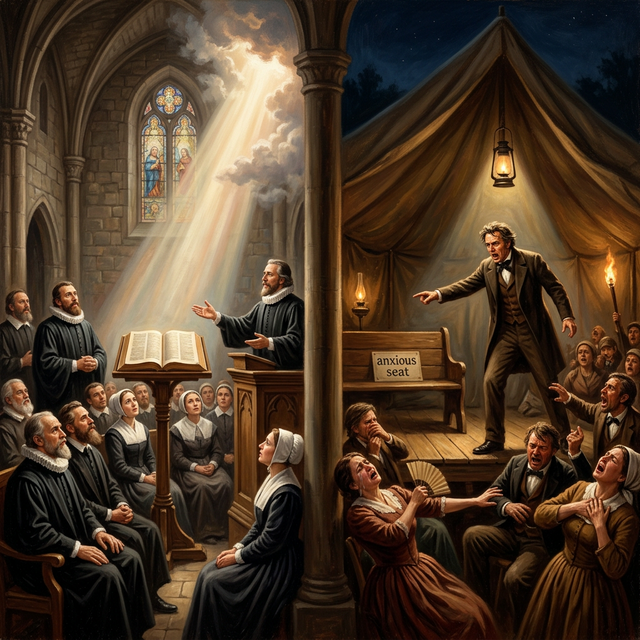
Most famously, he invented the “Anxious Seat”—a designated bench at the front where those “under conviction” were pressured to sit and make their transition. Finney openly denied the doctrine of original sin, believing man had the natural ability to turn to God by sheer willpower.
“A revival is not a miracle, or dependent on a miracle, in any sense. It is a purely philosophical result of the right use of the constituted means—as much so as any other effect produced by the application of means.” — Charles Finney, Lectures on Revivals of Religion
Finney effectively downgraded the Gospel from a Divine Decree to a Marketing Suggestion. He no longer waited for God to move; he sought to force God’s hand through human psychology.
5. The Current Crisis: False Assurance and “The Gospel of Satan”
The legacy of Finney’s decisionism is the spiritual wasteland we see today. A.W. Pink, in his piercing work The Gospel of Satan, warned that the most dangerous lie is not a total denial of truth, but a “counterfeit Gospel” that looks like the real thing but lacks its power.
"The 'Gospel' of Satan is not a system of revolutionary principles... it is a system of error which contains just enough truth to make it acceptable to the unwary... It is not the 'holding up of the hand' or 'signing a card' which makes a man a Christian... salvation is a miracle of grace, and not the result of some 'decision' made by the sinner." — A.W. Pink, *The Gospel of Satan*
Cheap Grace is the fruit of decisionism: salvation without repentance, justification without a new nature. Millions possess a “false assurance” because they once “did a gesture” (raised a hand or walked an aisle), yet their souls remain unregenerate, still dead in their sins.
6. Conclusion: Returning to the Throne of God
The solution to the era of decisionism is not “better techniques,” but a return to the Sovereignty of God. We must declare that the Gospel is not a deal we make with God, but a summons from the King to dead men.
As Reformed believers, we affirm: God commands all men to repent (highlighting our responsibility), but God Himself grants that repentance (highlighting His sovereign grace). We do not need more psychological tricks; we need a renewed awe for the Lord of the Harvest who alone can breathe life into dry bones.
"Free-will has carried many souls to hell, but never a soul to heaven yet." — C.H. Spurgeon
Soli Deo Gloria.
1. 序言:当救赎变成一个“动作”
每当我们参加现代布道会时,总会看到一个熟悉的场景:灯光调暗,煽情的背景音乐响起,布道家带着哭腔呼吁:“只要你走下这条走廊,举起你的手,或者跟我做这个祷告,你就得救了。” 这已经成为了我们这个时代救恩的“标准营销手段”。但我们必须追问一个核心问题:这种“为基督做决定”的权力,究竟是圣经的吩咐,还是人造的传统?
2. 前世:多特会议与“死人的复活”
要了解我们是在哪里走入歧途的,我们必须回到1618年的荷兰多德雷赫特(Dordrecht)。归正信仰的教父们并不认为罪人仅仅是“病了”或者“属灵上困惑”。根据圣经,他们明白人是“死在过犯和罪恶之中”的——不是正在溺水,而是已经沉入海底。
在多特会议所阐述的圣经逻辑中,重生(Regeneration)必须在信心之先。 一个死人不能“决定”活着。上帝必须先赐下“肉心”,人才会悔改。救赎不是人在上帝帮助下完成的工程;它是上帝超自然的单边作为(Monergism),将死人召回生命。
[以西结书 36:26-27]
“我也要赐给你们一个新心,将新灵放在你们里面,又从你们的肉体中除掉石心,赐给你们肉心。我必将我的灵放在你们里面,使你们顺从我的律例,谨守遵行我的典章。”(和合本)
{: .lang-zh lang="zh-CN"}

[以弗所书 2:1, 4-5]
“你们死在过犯圣罪之中……然而,神既有丰富的怜悯,因他爱我们的大爱,当我们死在过犯中的时候,便叫我们与基督一同活过来。你们得救是本乎恩。”(和合本)
“当上帝在选民心中成就祂的美意时……祂在他们里面既产生相信的愿望,也产生相信的行为……这是一件超自然的工作,极其有力,同时又极其令人喜悦、惊异、奥秘且不可言说;其效力绝不亚于创造或死人复活。” —— 《多特信经》,第三/四章,第十二条
3. 转折:理性的侵蚀与神秘感的消亡
到了19世纪初,西方的知识界经历了地震般的位移。在自然科学领域,以查尔斯·莱尔(Charles Lyell)为代表的均变论(Uniformitarianism)开始占据主导地位。这种观点认为宇宙是由固定、缓慢且恒定的规律支配的,“现在是通往过去的钥匙”。这种思维实质上将上帝直接、主权性的干预从自然界的叙事中“放逐”了。
这种科学理性主义很快就渗透进了圣所。新一代的思想家开始将同样的逻辑应用到灵魂上:如果物质世界是按照可预测的因果律运行的,那么属灵世界凭什么会有所不同呢?启蒙运动强调人的理性和自主性,这种神学环境使得上帝的主权作为逐渐被某种“可控性”所取代。
在第一次大觉醒时期,以爱德华兹(Jonathan Edwards)为代表的古老归正观将复兴视为“上帝奇妙的作为”——一种类似于创造本身的、主权性的神迹,没有任何人可以策划。爱德华兹在其代表作《宗教情感》(Religious Affections)中,细致地分辨了何为圣灵动工产生的真实体验,何为纯粹的人为情感煽动。他明白真实的悔改是超自然新生命的注入,而非人类说服术的产物。但在启蒙运动的影响下,这种神秘感被侵蚀了。复兴的“神迹”被降级为公式的“结果”。人们认为,只要你施加正确的心理压力,使用正确的情感触发顺序,并优化布道“手段”,复兴就必然会发生。讲坛不再是宣告君王敕令的地方,它变成了人类实施心理操控和“主宰灵魂”的实验室。
4. 今生:查尔斯·芬尼与救恩的“工业化”
现代决志主义真正的“父亲”是查尔斯·芬尼(Charles Grandison Finney)。芬尼曾是一名律师,他把讲坛当作法庭,把会众当作需要被说服的陪审团。他引入了“新手段”(New Measures)——这些技术旨在剥离人的心理防御,制造出一场人为的心理危机。
最著名的是,他发明了“焦虑座”(Anxious Seat)——讲台前一个特定的长凳,那些“感到扎心”的人被施加压力坐到那里,完成他们的“转变”。芬尼公开否认原罪教义,认为人有一种天然的能力,可以仅凭意志力就转向神。
“复兴在任何意义上都不是神迹,也不依赖于神迹。它纯粹是正确使用既定手段的哲学结果——就像其他任何通过手段产生的效果一样。” —— 查尔斯·芬尼,《宗教复兴讲义》
芬尼实际上将福音从“神的命令”降级为了“人的营销建议”。他不再等候上帝动工,而是试图通过人类心理学来“强迫”上帝动工。
5. 现状:虚假的确据与“撒旦的福音”
芬尼决志主义遗留给我们的,是今天我们看到的属灵荒原。阿瑟·宾克(A.W. Pink)在他犀利的著作《撒旦的福音》(The Gospel of Satan)中警告说,最危险的谎言不是全然否认真理,而是那种看起来像真的、却缺乏大能的“伪造福音”。
“撒旦的‘福音’不是一套革命性的原则……它是一套包含了足够真理以引诱不设防者的错误体系……使一个人成为基督徒的不是‘举手’或‘签卡’……救赎是恩典的奇迹,而不是罪人做出的某种‘决定’的结果。” —— 阿瑟·宾克,《撒旦的福音》
“廉价恩典”是决志主义的果实:没有悔改的救赎,没有新生命的称义。数以百万计的人拥有“虚假的确据”,因为他们曾经“做过一个动作”(举手或走到台前),然而他们的灵魂并未重生,仍死在罪中。
6. 结语:重回上帝的宝座
解决这个决志主义时代的方案不是“更好的技术”,而是回归上帝的主权。我们必须宣告:福音不是我们与上帝达成的一项协议,而是万王之王向死人发出的命令。
作为归正信仰的信徒,我们确认:上帝命令所有的人悔改(凸显了人的责任),但上帝亲自赐下那悔改(凸显了祂主权的恩典)。 我们不需要更多的心理手段;我们需要重新敬畏那位庄稼的主,唯独祂能向枯骨吹气,使其复生。
“自由意志已经把许多灵魂送进了地狱,但至今还没有把一个灵魂送进天堂。” —— 司布真
唯独上帝得荣耀。