The Hammer and the Gospel: The 95 Theses and the Five Solas 铁锤与福音:九十五条论纲与五大唯独
A comprehensive exploration of Martin Luther's 95 Theses and how they evolved into the foundational Five Solas of the Reformation. 全面探讨马丁·路德的《九十五条论纲》,以及它们如何演变为宗教改革奠基性的“五大唯独”。
Listen to English audio
聆听中文语音
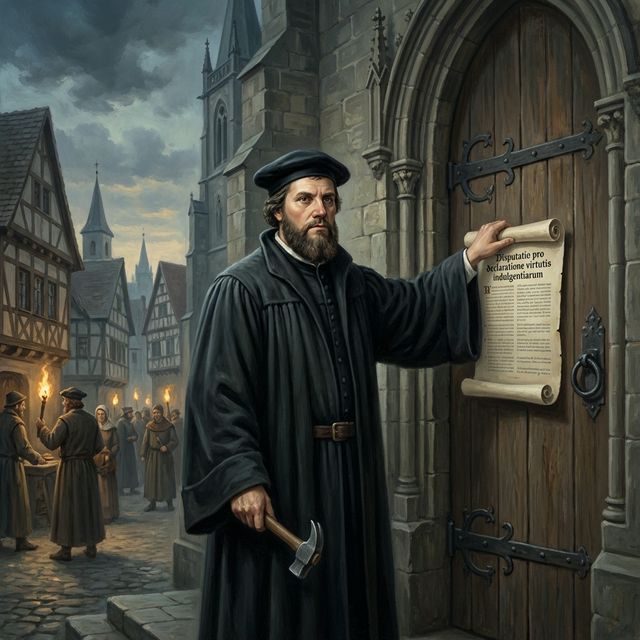
Introduction: An Invitation for Debate
On October 31, 1517, a Roman Catholic priest and theology professor named Martin Luther sent a letter to his archbishop and, according to tradition, nailed a list of 95 arguments to the door of All Saints’ Church in Wittenberg. This document, officially titled Disputatio pro declaratione virtutis indulgentiarum (Disputation on the Power of Indulgences), was not intended as a revolutionary manifesto or a break from the Church. It was, at its heart, an academic invitation for debate.
Luther, at the time a loyal servant of the Church, was deeply concerned about the abuse of “indulgences”—certificates sold by the Church that purportedly reduced the temporal punishment for sins.
导言:一份辩论的邀请
1517年10月31日,一位名叫马丁·路德的天主教神父兼神学教授向他的大主教寄出了一封信,并根据传统,在维滕贝格大教堂的大门上贴出了一份包含95条论点的清单。这份公文的正式名称是《关于赎罪券效力的辩论》(Disputatio pro declaratione virtutis indulgentiarum),其初衷并非要发表革命宣言或脱离教会。从核心上讲,它是一份邀请学术辩论的提纲。
当时路德还是一名忠诚的天主教会仆人,他针对当时教会出售“赎罪券”(宣称可以减轻对罪的暂时惩罚的证书)的乱象,提出了深切的质疑。
Martin Luther’s academic protest in Wittenberg
1. Repentance is a Lifetime Journey
The very first thesis struck a thunderous note: “When our Lord and Master Jesus Christ said, ‘Repent’ (Matt 4:17), he willed the entire life of believers to be one of repentance.”
- The Theological Meaning: Luther argued that a sinner’s transformation is a long-term internal process, not something that can be “settled” through a simple confession or the purchase of a piece of paper (an indulgence). True repentance is not a transaction; it is a posture of the heart before God.
1. 悔改是一辈子的事(核心神学)
论纲的第一条就极具震撼力:“当主耶稣基督说‘你们应当悔改’(马太福音4:17)时,他的意愿是希望信徒们毕生致力于悔改。”
- 含义: 路德认为罪人的转变应当是内心的长期过程,而不是通过买一张纸(赎罪券)或者一次简单的告解就能“两清”的。真正的悔改不是一桩交易,而是心对上帝的一种持续姿态。
2. Indulgences Cannot Buy Salvation
Luther launched a fierce attack on the contemporary slogan: “As soon as the coin in the coffer rings, the soul from purgatory springs.”
- Limited Papal Power: He pointed out that the Pope only has the authority to remit penalties imposed by the Church’s own law (such as earthly penance), not to remove God’s judgment over sin.
- No Power Over the Dead: He argued that the Pope has no jurisdiction over souls in purgatory. The idea that common people could buy their relatives’ way out of suffering was, in Luther’s view, a deceptive lie.
- The True “Treasury”: Thesis 62 states: “The true treasure of the Church is the most holy gospel of the glory and grace of God.” Salvation is an unmerited gift of God’s grace, and it is free.
2. 赎罪券买不来救赎
路德猛烈抨击了当时“钱币叮当响,灵魂出炼狱”的说法。
- 教皇的权力有限: 他指出教皇只能赦免教会法典规定的惩罚(比如世俗的补赎),而不能免除上帝对罪的审判。
- 不能救死人: 他认为教皇对炼狱里的灵魂没有管辖权,认为赎罪券能让亲人灵魂跳出炼狱纯属谎言。
- 真正的“财宝”: 第62条写道:“教会的真正宝藏是彰显上帝荣耀和恩典的至圣福音。”他认为救赎是上帝的恩典,是免费的馈赠。
3. Attacking Greed and Corruption
Luther included several sharp “critiques” that resonated deeply across the German lands:
- Where is the Money Going? At the time, Pope Leo X was issuing indulgences on a massive scale to fund the construction of St. Peter’s Basilica. In Thesis 86, Luther asked: “Why does not the pope, whose wealth is today greater than the wealth of the richest Crassus, build this one basilica of St. Peter with his own money rather than with the money of poor believers?”
3. 抨击教会的贪婪与腐败
路德在论纲中加入了一些非常尖锐的“吐槽”,这在德意志地区引发了巨大共鸣:
- 钱去哪了? 当时教皇利奥十世为了修建圣彼得大教堂而大规模发售赎罪券。路德在第86条质问:“教皇现在的财富比古代最富有的人还多,他为什么不掏自己的腰包,而要用贫穷信徒的钱来盖圣彼得大教堂呢?”
4. The Responsibility of Christians
He believed that indulgences gave people a “false sense of peace,” leading them to believe they were secure because they had bought a certificate, thus causing them to neglect true works of mercy.
- Helping the Poor is More Important: Thesis 45 mentions that a person who sees a brother in need and passes him by to give money for indulgences does not buy the Pope’s indulgence, but the wrath of God.
4. 基督徒应承担责任
他认为赎罪券给人一种“虚假的平安感”,让人以为买了券就安全了,从而忽视了真正的善行。
- 周济穷人更重要: 第45条提到,如果一个人看到弟兄困苦却不施援助,反而花钱买赎罪券,他得到的不是教皇的赦免,而是上帝的愤怒。
The Historical Truth: Nailing or Posting?
While traditional paintings often depict Martin Luther dramatically nailing his list to the church door, modern historians suggest he may have sent the letter to the Bishop and posted the theses on the university bulletin board (which happened to be the church doors at the time).
Why did it spread so fast?
Originally written in Latin for academic discussion, the 95 Theses were translated into German and reproduced using the Printing Press. In just two weeks, they spread across Germany; within a month, they were known throughout Europe. What began as a local attempt to fix a loophole in the Church became the spark that ignited the Protestant Reformation.
历史真相:他真的把纸钉在门上了吗?
虽然传统画作常描绘马丁·路德在维滕贝格大教堂门上钉布告的情景,但现代史学家认为他更有可能是把信寄给了主教,并把提纲贴在了大学布告栏上(当时的教堂大门常充当大学的布告栏)。
为什么这95条会火?
本来这只是用拉丁文写的学术讨论稿,但因为印刷术的普及,有人将其翻译成德语并大量复印。短短两周内,这些观点传遍了德意志,一个月内传遍了全欧洲。它原本只是想修补教会的漏洞,结果却像火星掉进了火药桶,引发了波澜壮阔的宗教改革。
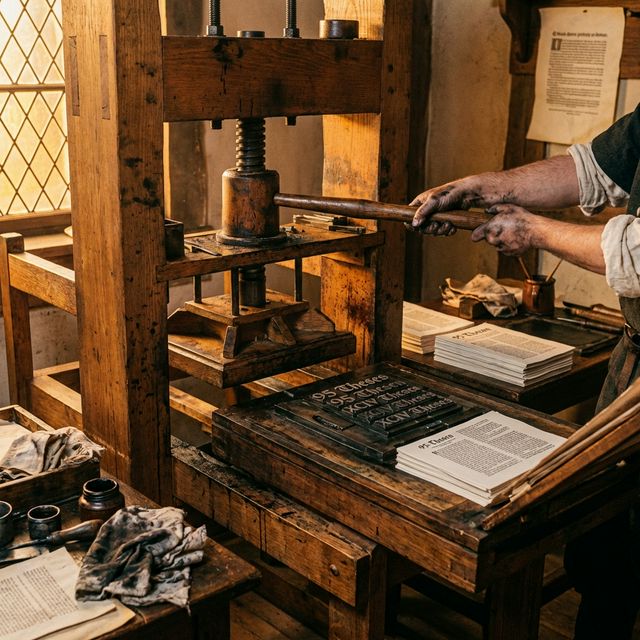 The Gutenberg Printing Press: The engine of the Reformation
The Foundation: The Five Solas
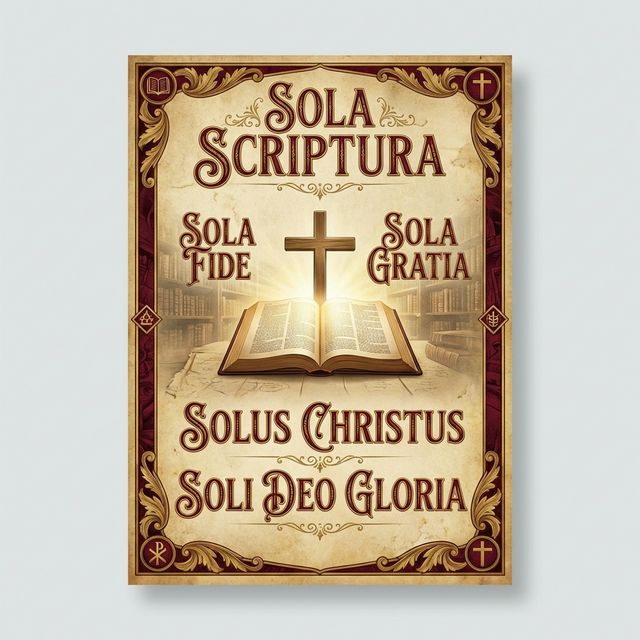
The theological shifts started by the 95 Theses eventually crystallized into five core principles, known as the Five Solas. These Latin phrases summarize the essential differences between the Reformers and the medieval Church:
- Sola Scriptura (Scripture Alone): The Bible is the only supreme authority for faith and practice, above any Pope or tradition.
- Sola Fide (Faith Alone): Justification is by faith alone in Christ, not by works or buying indulgences.
- Sola Gratia (Grace Alone): Salvation is a free gift of God’s unmerited grace.
- Solus Christus (Christ Alone): Christ is the only mediator between God and man.
- Soli Deo Gloria (To God Alone the Glory): All glory belongs to God alone.
信仰的基石:五大唯独
马丁·路德的《九十五条论纲》引发的神学转变,最终凝结成了五个核心原则,即“五大唯独”(The Five Solas)。这些拉丁语短语总结了宗教改革者与中世纪教会之间的本质区别:
- Sola Scriptura (唯独圣经): 圣经是信仰的唯一最高权威,而非教皇或传统。
- Sola Fide (唯独信心): 人得救是靠着对上帝的信心,而不是靠买赎罪券或做善功。
- Sola Gratia (唯独恩典): 救赎是上帝白白赐予的礼物,不是人赚来的。
- Solus Christus (唯独基督): 基督是上帝与人之间唯一的仲介,不需要通过神职人员的特殊权力。
- Soli Deo Gloria (唯独上帝的荣耀): 一切荣耀都只归给上帝。
Full Text of the 95 Theses
Below is the full bilingual text of the 95 Theses, categorized by their theological focus.
《九十五条论纲》全文
以下是《九十五条论纲》的全文中英对照,按其神学重点分类。
Out of Love for the Truth
Out of love for the truth and the desire to bring it to light, the following propositions will be discussed at Wittenberg, under the presidency of the Reverend Father Martin Luther, Master of Arts and of Sacred Theology, and Lecturer in Ordinary on the same at that place. Wherefore he requests that those who are unable to be present and debate orally with us, may do so by letter. In the Name of our Lord Jesus Christ. Amen.
出于对真理的爱和追求
出于对真理的爱和启发的愿望,下列命题将在维滕堡由文学和神学硕士、维滕堡大学常任讲师马丁·路德神父主持辩论。他请不能到场参加口头辩论的人以书面形式参加。奉主耶稣基督之名。阿门。
I. On True Repentance (Theses 1-4)
- When our Lord and Master Jesus Christ said, “Repent” (Mt 4:17), he willed the entire life of believers to be one of repentance.
- This word cannot be understood as referring to the sacrament of penance, that is, confession and satisfaction, as administered by the clergy.
- Yet it does not mean solely inner repentance; such inner repentance is worthless unless it produces various outward mortification of the flesh.
- The penalty of sin remains as long as the hatred of self (that is, true inner repentance), namely till our entrance into the kingdom of heaven.
一、 关于真实的悔改(1-4条)
- 当我们的主耶稣基督说“你们应当悔改”(马太福音4:17)时,祂的意思是信徒的整个生命应当是悔改的。
- “悔改”一词不能理解为圣礼中的忏悔(即神父主持下的告解和补赎)。
- 这话也不仅指内心的悔改;如果内心悔改不能在外部产生各种对肉体的克制,那这种悔改就是无效的。
- 这种惩罚(罪的惩罚)会一直持续到人自恨(即内心的真实悔改)为止,直到我们进入天国。
II. Limits of Papal Authority (Theses 5-20)
- The pope has neither the will nor the power to remit any penalties beyond those imposed either at his own discretion or by canon law.
- The pope cannot remit any guilt, except by declaring and showing that it has been remitted by God.
- God remits guilt to no one unless at the same time he humbles him in all things and makes him submissive to the vicar, the priest.
- The penitential canons are imposed only on the living, and, according to the same canons, nothing should be imposed on the dying.
- Therefore the Holy Spirit, through the pope, is kind to us insofar as the pope, in his decrees, always makes exception of the article of death and of necessity.
- Ignorant and wicked are the doings of those priests who, in the case of the dying, reserve canonical penances for purgatory.
- This changing of the canonical penalty to the penalty of purgatory is quite evidently one of the tares that were sown while the bishops slept (Mt 13:25).
- In former times canonical penalties were imposed, not after, but before absolution, as tests of true contrition.
- The dying are freed by death from all penalties, are already dead as far as the canon laws are concerned, and have a right to be released from them.
- Imperfect piety or love on the part of the dying person necessarily brings with it great fear; and the smaller the love, the greater the fear.
- This fear or horror is sufficient in itself, to say nothing of other things, to constitute the penalty of purgatory, since it is very near to the horror of despair.
- Hell, purgatory, and heaven seem to differ the same as despair, fear, and assurance of salvation.
- It seems as though for the souls in purgatory fear should necessarily decrease and love increase.
- Furthermore, it does not seem proved, either by reason or by Scripture, that souls in purgatory are outside the state of merit, that is, unable to grow in love.
- Nor does it seem proved that souls in purgatory, at least not all of them, are certain and assured of their own salvation, even if we ourselves may be very certain of it.
- Therefore the pope, when he uses the words “plenary remission of all penalties,” does not actually mean “all penalties,” but only those imposed by himself.
二、 教皇权力的限制(5-20条)
- 教皇没有免除任何罪责的意愿和权力,他只能赦免凭他自己的权力或教会法典所施加的惩罚。
- 教皇不能赦免任何罪债,而只能宣布并证明罪债已由上帝赦免。
- 上帝赦免任何人的罪债时,同时也使他在凡事上顺服于祂的代表——神父。
- 教会的悔罪条例只适用于活人,而不适用于死者。
- 圣灵通过教皇对我们施恩:教皇在他的法令中始终把死亡和穷困视为例外。
- 那些将教条所定的补赎留到炼狱里的神父,其行为是无知且邪恶的。
- 将教会法典的惩罚转变为炼狱的惩罚,显然是仇敌(魔鬼)在主教们睡觉时撒下的稗子。
- 从前,教典所定的惩罚是在赦罪之前施加的,作为真实痛悔的考验。
- 临终者因死亡而免除了所有的惩罚,对于教典的法规来说他们已经死了,不再受其约束。
- 临终者心灵的健康(即爱心)若不完全,必然会带来极大的恐惧,爱心越小,恐惧越大。
- 这种恐惧和惊惶本身就足以构成炼狱的惩罚,因为它与绝望的恐惧相距不远。
- 地狱、炼狱和天堂的区别,似乎与绝望、将近绝望和确信的区别相同。
- 对于炼狱里的灵魂,恐惧似乎必须减少,而爱心必须增加。
- 无论是凭理性还是凭经文,都无法证明炼狱里的灵魂已脱离了功德或爱心的增长。
- 同样无法证明炼狱里的灵魂(至少不是全部)确信自己已得救,尽管我们对此深信不疑。
- 因此,教皇所说的“完全赦免一切惩罚”,并非指所有的惩罚,而仅指他自己施加的惩罚。
III. Errors Regarding Indulgences (Theses 21-40)
- Thus those indulgence preachers are in error who say that a man is absolved from every penalty and saved by papal indulgences.
- As a matter of fact, the pope remits to souls in purgatory no penalty which, according to canon law, they should have paid in this life.
- If remission of all penalties whatsoever could be granted to anyone at all, certainly it would be granted only to the most perfect, that is, to very few.
- For this reason most people are necessarily deceived by that indiscriminate and high-sounding promise of release from penalty.
- That power which the pope has in general over purgatory is the same as the power which any bishop or curate has in particular within his own diocese or parish.
- The pope does very well when he grants remission to souls in purgatory, not by the power of the keys, which he does not have, but by way of intercession for them.
- They preach only human doctrines who say that as soon as the money clinks into the money box, the soul flies out of purgatory.
- It is certain that when money clinks in the money box, greed and avarice can be increased; but when the church intercedes, the result is in the hands of God alone.
- Who knows whether all souls in purgatory wish to be redeemed, as we are told back by the legend of St. Severinus and Paschal?
- No one is sure of the integrity of his own contrition, much less of having received plenary remission.
- The man who actually buys indulgences is as rare as he who is actually penitent; indeed, he is exceedingly rare.
- Those who believe that they can be certain of their salvation because they have indulgence letters will be eternally damned, together with their teachers.
- Men must especially be on their guard against those who say that the pope’s pardons are that inestimable gift of God by which man is reconciled to him.
- For the grace of these pardons concerns only the penalties of sacramental satisfaction that have been devised by men.
- They who teach that contrition is not necessary on the part of those who intend to buy souls out of purgatory or to buy confessional privileges preach unchristian doctrine.
- Any truly repentant Christian has a right to full remission of penalty and guilt, even without indulgence letters.
- Any true Christian, whether living or dead, participates in all the blessings of Christ and the church; and this is granted him by God, even without indulgence letters.
- Nevertheless, papal remission and blessing are by no means to be disregarded, for they are, as I have said (Thesis 6), the proclamation of divine remission.
- It is very difficult, even for the most learned theologians, at one and the same time to commend to the people the abundance of indulgences and the need of true contrition.
- A Christian who is truly contrite seeks and loves to pay penalties for his sins; the greed of indulgences, however, relaxes penalties and causes men to hate them.
三、 关于赎罪券的错谬(21-40条)
- 因此,那些宣扬“靠教皇的赎罪券,人可以免除一切惩罚并得救”的传道士,是在犯错误。
- 事实上,教皇对炼狱里的灵魂没有任何惩罚的豁免权,因为那些惩罚本该在这一生根据教典去履行。
- 如果任何人真的能得到完全的赦免,那也只有最完美的人才能得到,而这种人极少。
- 因此,大多数人必然被那不分青红皂白、夸大其辞的赦免应许所欺骗。
- 教皇对炼狱的一般权力,与任何主教或神父在自己的教区或堂区内所拥有的权力是相同的。
- 教皇通过“代求”而非“权柄”给予灵魂赦免,这是做得非常对的。
- 那些宣称“钱币叮当一声落入钱柜,灵魂就瞬间跳出炼狱”的人,是在传人的教条。
- 钱币叮当响时,增加的只是贪婪和私欲;至于教会的代求,则全凭上帝的旨意。
- 炼狱里的灵魂是否都想被赎出来?谁知道呢(正如关于圣塞法里努斯和圣帕斯卡的传说)。
- 没有人能确定自己的痛悔是真实的,更不用说确定自己得到了完全的赦免。
- 真实购买赎罪券的人和真实悔改的人一样稀少。
- 那些相信靠着赎罪券就能确信得救的人,将与他们的老师一起永远沉沦。
- 我们必须特别警惕那些说教皇的赦免是上帝给人的“无价礼物”、使人能与上帝和好的人。
- 因为赎罪券的恩典仅涉及由人设立的补赎惩罚。
- 那些教导说购买赎罪券就不需要痛悔的人,所传的不是基督的道理。
- 每一个真正痛悔的基督徒,即使没有赎罪券,也完全脱离了罪责和惩罚。
- 每一个真实的基督徒,无论是活人还是死人,都有份于基督和教会的所有财宝,这是上帝赐予的,与赎罪券无关。
- 但教皇给予的赦免不容蔑视,因为正如我所说,这是对神圣赦免的宣告。
- 即使是最博学的神学家,也很难在宣扬赎罪券的好处时,同时又强调真实痛悔的必要。
- 真实的痛悔寻求并喜爱惩罚;但赎罪券的慷慨却使人逃避惩罚,并导致人们厌恶惩罚。
IV. True Works and Church Responsibility (Theses 41-55)
- Papal indulgences must be preached with caution, lest people erroneously think that they are preferable to other good works of love.
- Christians are to be taught that the pope does not intend that the buying of indulgences should in any way be compared with works of mercy.
- Christians are to be taught that he who gives to the poor or lends to the needy does a better deed than he who buys indulgences.
- Because love grows through works of love, man actually becomes better; but through indulgences man does not become better, but only freer from penalties.
- Christians are to be taught that he who sees a needy man and passes him by, yet gives his money for indulgences, does not buy papal indulgences but God’s wrath.
- Christians are to be taught that, unless they have more than they need, they must reserve enough for their family needs and by no means squander it on indulgences.
- Christians are to be taught that the buying of indulgences is a matter of free choice, not commanded.
- Christians are to be taught that the pope, in granting indulgences, needs and thus desires their devout prayer more than their money.
- Christians are to be taught that papal indulgences are useful only if they do not put their trust in them, but very harmful if they lose their fear of God because of them.
- Christians are to be taught that if the pope knew the exactions of the indulgence preachers, he would rather that the basilica of St. Peter were burned to ashes than built up with the skin, flesh, and bones of his sheep.
- Christians are to be taught that the pope would and should wish to give of his own money, even though he had to sell the basilica of St. Peter, to many of those from whom certain hawkers of indulgences cajole money.
- It is vain to trust in salvation by indulgence letters, even though the indulgence commissary, or even the pope himself, were to offer his soul as a security.
- They are the enemies of Christ and the pope who forbid altogether the preaching of the Word of God in some churches in order that indulgences may be preached in others.
- Injury is done to the Word of God when, in the same sermon, an equal or larger amount of time is devoted to indulgences than to the Word.
- It is certainly the pope’s sentiment that if indulgences, which are a very small thing, are celebrated with one bell, one procession, and one ceremony, then the gospel, which is the very greatest thing, should be preached with a hundred bells, a hundred processions, a hundred ceremonies.
四、 真正的善行与教会责任(41-55条)
- 教皇的赦免必须谨慎宣扬,以免人们误以为它比慈善事业(善行)更重要。
- 必须教导基督徒:教皇并不认为购买赎罪券在任何程度上可以与怜悯的行为相提并论。
- 必须教导基督徒:周济穷人或借债给急需者,比购买赎罪券好得多。
- 因为爱通过善行增长,使人变得更好;而赎罪券并不能使人变得更好,只是让人逃避惩罚。
- 必须教导基督徒:人若看见弟兄穷苦却视而不见,反而花钱买赎罪券,他买到的不是教皇的赦免,而是上帝的愤怒。
- 必须教导基督徒:除非他们有足够的闲钱,否则他们应当留着钱供养家庭,绝不能浪费在赎罪券上。
- 必须教导基督徒:买赎罪券是自愿的事,不是命令。
- 必须教导基督徒:教皇在颁发赎罪券时,更需要也更希望得到信徒虔诚的祈祷,而不是他们交来的钱。
- 必须教导基督徒:教皇的赎罪券只有在人们不信靠它时才是有用的;但如果人们因它而失去对上帝的畏惧,它就是有害的。
- 必须教导基督徒:如果教皇知道赎罪券传道士的勒索行为,他宁肯让圣彼得大教堂化为灰烬,也不愿用信徒的皮、肉、骨来建造它。
- 必须教导基督徒:即使要教皇卖掉圣彼得大教堂,甚至自掏腰包,他也愿意把钱还给那些被赎罪券贩子骗走钱财的人。
- 靠赎罪券得救是虚妄的,即使赎罪券代理人甚至教皇本人以灵魂为抵押来作保。
- 那些为了宣扬赎罪券而下令在其他教堂禁讲上帝话语的人,是基督和教皇的敌人。
- 在同一次讲道中,如果花在赎罪券上的时间多于花在上帝话语上的时间,那就是对上帝话语的亵渎。
- 教皇的意思必然是:如果为了赎罪券(极小的事)而鸣钟、举行游行和仪式,那么为了福音(极大的事)就应当百倍地鸣钟、游行和举行仪式。
V. The True Treasure of the Church (Theses 56-80)
- The treasures of the church, out of which the pope distributes indulgences, are not sufficiently discussed or known among the people of Christ.
- That indulgences are not temporal treasures is certainly evident, for many of the sellers do not distribute them freely but only gather them.
- Nor are they the merits of Christ and the saints, for, even without the pope, the latter always work grace for the inner man, and the cross, death, and hell for the outer man.
- St. Lawrence said that the poor of the church were the treasures of the church, but he spoke according to the usage of the word in his own time.
- Without want of consideration we say that the keys of the church, given by the merits of Christ, are that treasure;
- For it is clear that the pope’s power is of itself sufficient for the remission of penalties and cases reserved by himself.
- The true treasure of the church is the most holy gospel of the glory and grace of God.
- But this treasure is naturally most odious, for it makes the first to be last (Mt 20:16).
- On the other hand, the treasure of indulgences is naturally most acceptable, for it makes the last to be first.
- Therefore the treasures of the gospel are nets with which one formerly fished for men of wealth.
- The treasures of indulgences are nets with which one now fishes for the wealth of men.
- The indulgences which the demagogues acclaim as the greatest graces are actually understood to be such only insofar as they promote gain.
- They are nevertheless in truth the most insignificant graces when compared with the grace of God and the piety of the cross.
- Bishops and curates are bound to admit the commissaries of papal indulgences with all reverence.
- But they are much more bound to strain their eyes and ears lest these men preach their own dreams instead of what the pope has commissioned.
- Let him who speaks against the truth concerning papal indulgences be anathema and accursed.
- But let him who guards against the lust and license of the indulgence preachers be blessed.
- Just as the pope justly thunders against those who by any means whatever contrive harm to the sale of indulgences.
- Much more does he intend to thunder against those who use indulgences as a pretext to contrive harm to holy love and truth.
- To consider papal indulgences so great that they could absolve a man even if he had done the impossible and had violated the mother of God is madness.
- We say on the contrary that papal indulgences cannot remove the very least of venial sins as far as guilt is concerned.
- To say that even St. Peter if he were now pope, could not grant greater graces is blasphemy against St. Peter and the pope.
- We say on the contrary that even the present pope, or any pope whatsoever, has greater graces at his disposal, that is, the gospel, spiritual powers, gifts of healing, etc., as it is written. (1 Co 12[:28])
- To say that the cross emblazoned with the papal coat of arms, which is set up [by the indulgence preachers], is of equal worth with the cross of Christ is blasphemy.
- The bishops, curates, and theologians who permit such talk to be spread among the people will have to answer for this.
五、 教会真正的宝藏(56-80条)
- 教皇借以颁发赎罪券的“教会宝藏”,在上帝的子民中既没有被充分界定,也没有被广泛知晓。
- 显然,这不是物质上的财宝,否则贩子们就不会只管积聚而不管散发了。
- 这也不是基督和圣徒的功德,因为这些功德不靠教皇就能在内部施恩给世人,在外部施加苦行和惩罚。
- 圣劳伦斯说教会的宝藏是教会的穷人,但他那是按当时的习惯用法说的。
- 我们坦率地说:由基督的功德所赋予的“教会的钥匙”才是那财宝。
- 因为很明显,教皇的权力足以免除由他施加的惩罚。
- 教会真正的宝藏,是关于上帝荣耀和恩典的圣洁福音。
- 但这财宝自然是最令人生厌的,因为它使在前的成为在后的。
- 而赎罪券的财宝自然是最受人欢迎的,因为它使在后的成为在前的。
- 因此,福音的宝藏是网,古时人们用它来网罗富有的人。
- 而赎罪券的财宝也是网,现今人们用它来网罗人的财宝。
- 传道士们大声吹嘘为“极大恩典”的赎罪券,之所以被看作极大,确实是因为它们能增加收益。
- 但事实上,与上帝的恩典和十字架的虔诚相比,它们是微不足道的。
- 主教和神父有义务以万分尊敬的心容纳教皇大赦代理人。
- 但他们更有义务用眼睛看,用耳朵听,以免这些代理人宣讲自己的梦幻,而不是教皇的指示。
- 凡说话反对教皇大赦真理的人,愿他受诅咒。
- 但凡为抵制赎罪券贩子的贪婪和放纵而担忧的人,愿他蒙福。
- 就像教皇理直气壮地打击那些通过各种手段阻碍赎罪券交易的人。
- 他更想打击那些以赎罪券为借口阻碍圣爱和真理的人。
- 认为教皇的赎罪券权力大到甚至能赦免一个做了不可能之事(如玷污圣母)的人,这种想法是疯狂的。
- 相反,我们认为:教皇的赎罪券甚至连最微小的轻罪罪责都不能免除。
- 如果说即使圣彼得现在是教皇,他也不能赐下更大的恩典,这是对圣彼得和教皇的侮辱。
- 相反,我们说:现任教皇或任何教皇都有更大的恩典,即福音、权能、医治的恩赐等(哥林多前书12章)。
- 说印有教皇纹章的十字架(在售卖处竖起的)与基督的十字架具有同等效力,这是亵渎。
- 那些允许这种言论在民间流传的主教、神父和神学家,必须对此负责。
VI. Sharp Questions from the Laity (Theses 81-91)
- This unbridled preaching of indulgences makes it difficult even for learned men to rescue the reverence which is due the pope from slander or from the shrewd questions of the laity.
- Such as: “Why does not the pope empty purgatory for the sake of holy love and the dire need of the souls that are there if he redeems an infinite number of souls for the sake of miserable money with which to build a church?” The former reason would be most just; the latter is most trivial.
- Again, “Why are funeral and anniversary masses for the dead continued and why does he not return or permit the withdrawal of the endowments founded for them, since it is wrong to pray for the redeemed?”
- Again, “What is this new piety of God and the pope that for a consideration of money they permit a man who is impious and their enemy to buy out of purgatory the pious soul of a friend of God and do not rather, because of the need of that pious and beloved soul, free it for pure love’s sake?”
- Again, “Why are the penitential canons, which in actual fact and through disuse have long been abrogated and dead, now satisfied by the granting of indulgences, as though they were still alive and in force?”
- Again, “Why does not the pope, whose wealth is today greater than the wealth of the richest Crassus, build this one basilica of St. Peter with his own money rather than with the money of poor believers?”
- Again, “What does the pope remit or grant to those who by perfect contrition already have a right to full remission and blessings?”
- Again, “What greater blessing could come to the church than if the pope were to bestow these remissions and blessings on every believer a hundred times a day, as he now does but once?”
- “Since the pope seeks the salvation of souls rather than money by his indulgences, why does he suspend the indulgences and pardons granted heretofore, which have these same efficacious powers?”
- To repress these very sharp arguments of the laity by force alone, and not to resolve them by giving reasons, is to expose the church and the pope to the ridicule of their enemies and to make Christians unhappy.
- If, therefore, indulgences were preached according to the spirit and intention of the pope, all these doubts would be readily resolved.
六、 平信徒的尖锐质问(81-91条)
- 这种对赎罪券的无节制宣传,使得即使是博学的人,也很难在平信徒的尖锐质疑下维护教皇的尊严。
- 例如:既然教皇为了最可怜的理由(即为了盖一座教堂所需的臭钱)而救赎无数的灵魂,那他为什么不为了神圣的爱和灵魂的痛苦需要而清空炼狱呢?(这才是最正当的理由)。
- 又如:如果死者已得救赎,为何还要继续为他们举行周年追思弥撒?教皇为何不退还为死者设立的捐款?
- 又如:上帝和教皇怎能允许一个邪恶的人和上帝的敌人花钱救赎一个敬虔爱上帝的灵魂,却不愿为了那敬虔灵魂自身的需要而无偿地救赎他?
- 又如:那些关于悔罪的教典早已废置不用了,为何现在还要靠颁发赎罪券来免除这些教典的惩罚,仿佛这些教典依然有效?
- 又如:教皇现在的财富比最富有的克拉苏(古罗马富豪)还多,他为什么要用贫穷信徒的钱,而不是用他自己的钱来建造圣彼得大教堂呢?
- 又如:对于那些通过真实痛悔已经获得完全赦免和恩典的人,教皇还能给予什么赦免或恩典呢?
- 又如:如果教皇不是每天只给信徒颁发一次赦免,而是每天颁发一百次,这对教会岂不是更大的福祉?
- 既然教皇发放赎罪券是为了拯救灵魂,而不是为了钱,那么他为何废止以前颁发的同样有效的赦免和券书?
- 如果只用武力压制平信徒这些尖锐的质问,而不通过说明理由来解决,就是让教会和教皇在敌人面前遭受嘲笑,让基督徒感到不安。
- 因此,如果赎罪券是按照教皇的本意和精神宣扬的,所有这些质疑都会迎刃而解。
VII. Conclusion (Theses 92-95)
- Away, then, with all those prophets who say to the people of Christ, “Peace, peace,” and there is no peace! (Jer 6:14)
- Blessed be all those prophets who say to the people of Christ, “Cross, cross,” and there is no cross!
- Christians should be exhorted to be diligent in following Christ, their Head, through penalties, death and hell.
- And thus be confident of entering into heaven through many tribulations rather than through the false security of peace (Acts 14:22).
七、 总结(92-95条)
- 滚开!那些向基督徒说“平安,平安”而其实没有平安的先知。
- 祝福!那些向基督徒说“十字架,十字架”而其实没有十字架的先知。
- 应当劝勉基督徒:要努力通过痛苦、死亡和地狱去跟随他们的头——基督。
- 因此要确信:进入天国要经历许多艰难,而不是靠虚假的平安担保。
Theological Implications: From Indulgences to Grace
The 95 Theses shifted the focus from human-effort-based redemption toward a radical reliance on the grace of God. This eventually led to the clarity of the Five Solas, ensuring that every believer could approach the throne of grace directly through Jesus Christ.
If you are interested in how these arguments led to specific legal or religious consequences in Europe, we can explore the Diet of Worms or the Confession of Augsburg in future articles.
神学意义:从赎罪券到恩典
《九十五条论纲》将焦点从基于人为努力的救赎转向了对上帝恩典的彻底依赖。这最终演变成了清晰的“五大唯独”,确保每一位信徒都能通过耶稣基督直接来到施恩宝座前。
如果你对这些论点如何导致欧洲特定的法律或宗教后果感兴趣,我们可以在未来的文章中探讨《沃尔姆斯议会》或《奥古斯堡信条》。